Agoda Keeps Drip Pricing in Korea Despite Government Sanctions
Agoda still shows a lower price on its first screen than at checkout for Korean hotel bookings, despite regulatory action and a 2024 dark pattern rule.
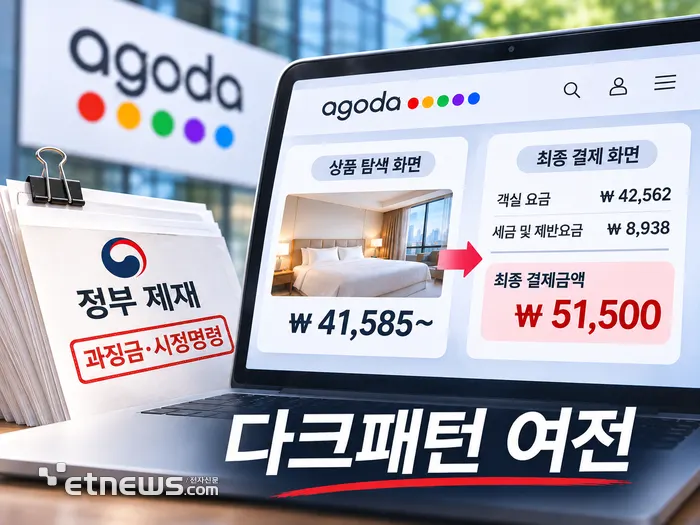
Online travel agency Agoda continues to show a lower price on its first screen than the final amount charged for accommodation bookings in South Korea, even after repeated government sanctions. A test of the booking flow on 3 November found that the price in the search results differed from the price shown before payment.
At the final payment step, a charge labeled "taxes and other fees" of about 9,000 won was added, bringing the stated price to 51,500 won. The same pattern repeated for products with other conditions. This practice is known as drip pricing, a type of dark pattern that lures consumers with a low headline price.
Years of warnings, little change
The Korea Consumer Agency flagged the problem in 2023. In February last year, the government put into force an amendment to the e-commerce act that regulates this type of dark pattern. Even so, the practice has persisted for years, raising concerns about consumer harm and about unfair competition against domestic companies that operate by the rules.
Agoda did fix the issue for flights. The Fair Trade Commission's Seoul regional office investigated its flight listings in February, confirmed violations, and closed the case with a warning on 22 October because the company corrected the problem voluntarily during the probe.
Accommodation is different. In July, the media and communications regulator fined Agoda 2.424 billion won and issued a corrective order. It cited, among other things, the failure to clearly disclose that choosing "pay later" can add a surcharge of up to 5%.
Broader investigation under way
Since May, the Fair Trade Commission has separately been investigating dark patterns at four online travel companies: Agoda, NOL Universe, Yanolja's rival Yeogi Eottae and Booking.com.
Experts say pressure on global platforms should rise. Lee Woo-jin, dean of the Graduate School of Global Entrepreneurship and Venture at Kookmin University, said that if a company fails to improve despite sanctions, it should explain exactly why, and the government should send a clearer message and demand effective measures.
Apps worth a look
 SUMO: the number puzzle
Tap the right tiles, add them up, hit the target. Easy to learn, hard to master. Free, for all ages.
 Dialo: learn languages by speaking
Talk to an AI conversation partner; every sentence comes back corrected and explained in your language. 9 languages, A1 to C2.
 ediviewer: read EDI files like documents
Open EDIFACT and X12 messages, see every segment explained, convert to JSON/XML, export PDF and Excel. Runs locally, no upload.
More from this day
See all →Solgram raises over $1 million pre-seed for premium grocery

OpenAI Raises Bug Bounty Rewards to $172,000 in Security Push

Google: Videostrong Pre-Installed Malware on 1.3M Android Devices
Egypt Drafts Dedicated AI Law to Govern Use of the Technology
More in: Business
See all →
Freenow to disappear in Poland as Lyft takes over the brand

Moscow Court Fines Google and Telegram 18.4 Million Rubles
Standard Chartered launches tokenized deposits in Hong Kong