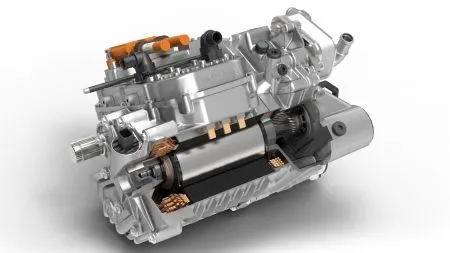
ZF High Revolution Drive: 30,000 rpm E-Motor Cuts Size and Weight
ZF's new 3-in-1 electric drive spins at up to 30,000 rpm, promising roughly 25 percent less space and weight and half the magnet mass of a current unit.
 SUMO· the number puzzle
 Dialo· learn languages by speaking
 ediviewer· read EDI files like documents
 giftdetect· the right gift in minutes
ZF has unveiled the High Revolution Drive, an electric axle drive whose motor turns at up to 30,000 rpm, nearly twice the speed of typical systems. Motor, inverter and gearbox share one housing, the 3-in-1 layout common in the industry. The supplier wants to save space, weight and magnet material from problematic supply chains without giving up efficiency.
Smaller, lighter, fewer magnets
ZF compares the design with a compact drive from its own Select platform that has identical output and reaches 18,000 rpm. Against it, the new unit is to take up almost 25 percent less space, weigh 25 percent less and use half the magnet mass. ZF gives no absolute dimensions, weights or definition of installation space. Pre-development engineer Stephan Demmerer said in an interview with VDI Wissensforum that he expects savings of about 22 kg on a drive that typically weighs 80 to 100 kg today.
The principle is simple: at equal power, a faster motor needs less torque at the shaft and can have a smaller rotor. A two-stage spur gearbox with an 18:1 ratio brings the speed down. The version shown delivers 200 kW peak power and 3,500 Nm of wheel torque; ZF publishes no continuous figures. The target is volume cars with 150 to 200 kW and 400 or 800 volt systems.
Open questions
ZF says efficiency matches the 18,000 rpm drive. Its product page cites up to 93 percent under WLTP and 13 percent lower system costs, though it is unclear whether the comparisons use the same system boundaries. High speeds stress rotor, bearings, cooling and gearing and add noise. Business unit head Thomas Meiser calls low noise and vibration hard development goals; ZF uses adapted tooth geometry and ribbed housings, and the prototype gets by with smaller bearings. Series suitability still has to be proven.
ZF does not name the magnet chemistry or how many rare earths are saved, so half the magnet mass does not mean half the dependency. BMW avoids magnets entirely with externally excited motors. The range gain is modest: roughly 0.13 kWh/100 km, or about 3 km on 400 km. The freed-up space may matter more to carmakers.
BYD, Xiaomi and GAC have also announced motors above 30,000 rpm, according to IDTechEx. ZF says it is talking to numerous carmakers but names none. Series production is planned by 2030, and the prototype has been on the test bench since February 2026.
Apps worth a look
SUMO: the number puzzleTap the right tiles, add them up, hit the target. Easy to learn, hard to master. Free, for all ages.
Dialo: learn languages by speakingTalk to an AI conversation partner; every sentence comes back corrected and explained in your language. 9 languages, A1 to C2.
ediviewer: read EDI files like documentsOpen EDIFACT and X12 messages, see every segment explained, convert to JSON/XML, export PDF and Excel. Runs locally, no upload.
giftdetect: the right gift in minutesPick who it is for, the occasion and their personality. The search engine reads product descriptions from local shops and ranks what fits. Free, no sign-up.
More from this day
See all →Nvidia-backed Hiverge quietly raises $19.4m with Plural

Sparkasse Introduces Click to Pay for Online Shopping on Nov 22

Delos Cloud: SAP Unit Targets Early 2027 Launch for German State

Medium Launches TK, an AI-Powered Note-Taking and Writing App
More in: Automotive
See all →
Tesla to End Cybertruck Production in Texas by Mid-2027
Volkswagen to Export China-Built Tech to Latin America, Africa

NHTSA Probes Whether Waymo's School Bus Recall Actually Worked