Vaticinaria gulicola: a new clam found living in a sea urchin's throat
A clam that lives inside a sea urchin's gullet has been named as a new species, about 50 years after Soviet researchers first spotted it without knowing what it was.
 SUMO· the number puzzle
 Dialo· learn languages by speaking
 ediviewer· read EDI files like documents
 giftdetect· the right gift in minutes
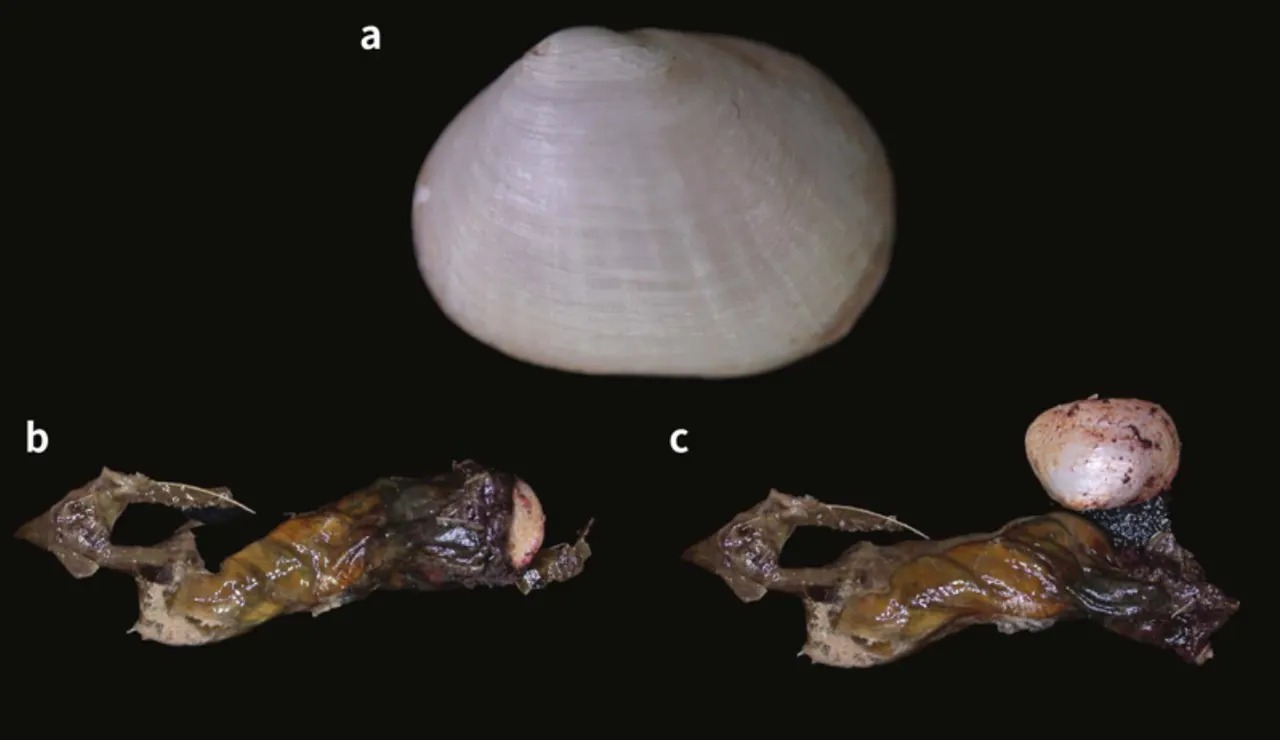
Some clams hide in the sand. This one hides in a sea urchin's throat. An international team led by researchers at Kyoto University has described a new species of bivalve, Vaticinaria gulicola, that lives in the oesophagus of a deep-sea urchin.
The team announced the find on 19 November. The urchins were collected off the southern coast of Australia, at depths of roughly 4,000 to 5,000 metres. The clam grows to about 19 mm and sits just behind the urchin's mouth. Its species name means "dweller of the throat".
The mystery is old. Soviet researchers reported a shell in the gut of the same kind of urchin back in the 1970s, but nobody could say what it was. After a close look at the shells and body structure, the team now says it is a new species.
What is Vaticinaria gulicola and why is it unusual?
The clam belongs to a superfamily called Galeommatoidea, where many members live alongside other animals. In shallow water, some relatives cling to the outside of sea urchins. But this is the first time a genus living inside an urchin's body has been confirmed.
What does the clam eat?
The urchin swallows seafloor mud, and that mud contains organic matter. The clam may be getting its food from it. Its body has a section lined with tiny projections, which the researchers think could strain the mud while drawing in water.
There is also a historical twist. Urchins collected during the British Challenger expedition of 1872 to 1876 were re-examined, and a related species, Vaticinaria moseleyi, turned up in the oesophagus of one. So a throat-dwelling clam was sitting in a roughly 150-year-old specimen all along.
How does it get in there in the first place? Nobody knows yet.
Apps worth a look
SUMO: the number puzzleTap the right tiles, add them up, hit the target. Easy to learn, hard to master. Free, for all ages.
Dialo: learn languages by speakingTalk to an AI conversation partner; every sentence comes back corrected and explained in your language. 9 languages, A1 to C2.
ediviewer: read EDI files like documentsOpen EDIFACT and X12 messages, see every segment explained, convert to JSON/XML, export PDF and Excel. Runs locally, no upload.
giftdetect: the right gift in minutesPick who it is for, the occasion and their personality. The search engine reads product descriptions from local shops and ranks what fits. Free, no sign-up.
More from this day
See all →
Roole Map adds an EV route planner that picks one trip for you

Anthropic CEO Dario Amodei denies AI should make human decisions

Character.AI bankruptcy sale: 41 states fight chat data auction