South Korean bank hacks: lenders rebuild account access controls
Hackers didn't touch the core banking systems. They walked in through tools used by loan brokers, staff and contractors, and Korean banks are now spending up to 2.8 times more on security.
 SUMO· the number puzzle
 Dialo· learn languages by speaking
 ediviewer· read EDI files like documents
 giftdetect· the right gift in minutes
The hackers behind a string of South Korean bank breaches skipped the vault. They went for the side doors: the work systems used by loan brokers, employees and outsourced staff, where the rules about who gets in were loose.
Now the banks are rebuilding those controls. Next year's information security budgets are rising by as much as 2.8 times.
What happened in the South Korean bank hacks
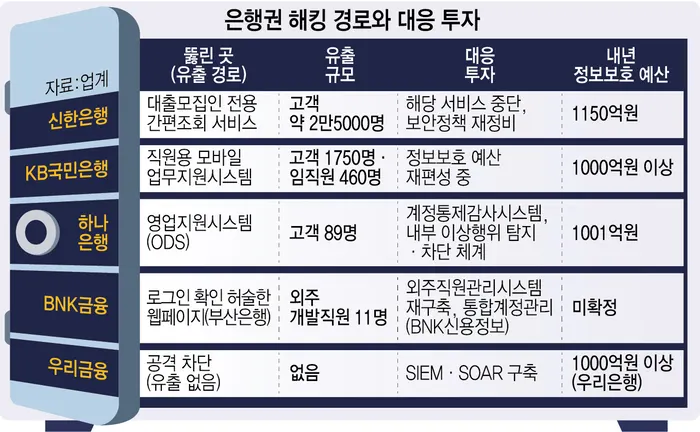
At Shinhan Bank, a quick-lookup service built for loan brokers leaked the annual income and loan limits of about 25,000 customers. At KB Kookmin Bank, a mobile work-support system for staff exposed data on 1,750 customers and 460 employees. At Hana Bank, an attack last month on a sales-support system (ODS) exposed the ID numbers, addresses and workplaces of 89 customers. Busan Bank found that a web page with weak login checks had exposed personal details of 11 outsourced developers.
The weak link in several cases was the API, the connection point that lets systems swap data. If a server doesn't re-check who is asking, changing an identifier such as a customer number can be enough to read someone else's record.
How banks are changing account and access management
Hana Bank has begun installing an account control and audit system that limits what each login can do and logs how it is used. BNK Financial Group's credit unit is building an integrated account management system, and Busan Bank is redoing its contractor management system. iM Financial's IT arm, iM Data Systems, is adding access control for network and security gear.
Detection is getting money too. Woori Financial is building a SIEM, which gathers access logs to spot odd behaviour, plus a SOAR system that blocks threats automatically. Hana is also buying equipment to detect and block suspicious activity from inside.
Shinhan will raise its security budget from 40.6 billion won to 115 billion won. Hana plans 100.1 billion won, while Woori and KB Kookmin each plan more than 100 billion won.
Is account management enough?
Not on its own. KB Kookmin has invested in account permissions and database access control since 2019, yet the leak came through an employee system open to the outside. Banks also need to check whether requests arriving from outside really have the right to ask.
The Financial Services Commission will inspect authentication, access control and API entry points at about 580 financial firms by year-end, and will look at the responsibility of CEOs and security chiefs. Between September 30 and November 3, 37 firms reported 40 incidents, with about 473,000 records leaked. A bank official said the key is how much of the new money goes to permission control and checking external entry points.
Apps worth a look
SUMO: the number puzzleTap the right tiles, add them up, hit the target. Easy to learn, hard to master. Free, for all ages.
Dialo: learn languages by speakingTalk to an AI conversation partner; every sentence comes back corrected and explained in your language. 9 languages, A1 to C2.
ediviewer: read EDI files like documentsOpen EDIFACT and X12 messages, see every segment explained, convert to JSON/XML, export PDF and Excel. Runs locally, no upload.
giftdetect: the right gift in minutesPick who it is for, the occasion and their personality. The search engine reads product descriptions from local shops and ranks what fits. Free, no sign-up.
More from this day
See all →
Comet 220P/McNaught suddenly got 1,000 times brighter. Here's why

Coral Hart used AI to write 370 books in 20 months

WhatsApp Zaps: self-deleting photos and videos for any chat

Green SM taxis: Karnataka halts new registrations, eyes mandatory meters
More in: Security
See all →
NoisyTCP Linux bug can crash a server remotely, no login needed
Artex AI hacking tool: FBI says it breaches networks in under three hours

Estonia's digital exile government: running the state from abroad