Seoul National University and Seoul to open Physical AI center
Seoul National University's engineering school and the Seoul city government will open an H-PAIR Physical AX Center at the Seoul AI Hub in Yangjae to test human-centered robots in real-life settings.
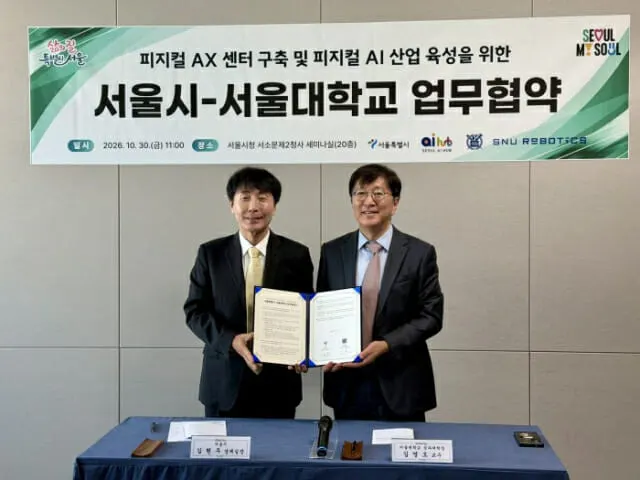
Seoul National University's College of Engineering and the Seoul Metropolitan Government will set up an "H-PAIR Physical AX Center" at the main center of the Seoul AI Hub in Yangjae. The aim is to move human-centered physical AI research out of the lab and into real-world testing and commercialization, the university said on November 1.
The two sides signed a memorandum of understanding on October 30 at the city's Seosomun No. 2 government building. The agreement runs for three years and can be extended by mutual consent.
A living lab for home robots
The first step is a 338-square-meter H-PAIR living lab on the fourth floor of the AI Hub, targeted to open in the first half of 2027. It will replicate a living room, kitchen and bedroom at full scale, and lighting, object placement and obstacles can be changed to mimic unstructured home environments. Performance, safety and user acceptance of robots will be assessed there.
Companies that are members or tenants of the Seoul AI Hub can test their own robots in the lab. The goal is to cut the time and cost of validation that individual firms would struggle to build alone. The center plans to support about five companies a year with dedicated staff, focusing initially on care and daily-assistance robots.
Research backing and next steps
The center builds on the H-PAIR national research lab, which draws on 16 departments and graduate schools and 41 full-time professors. It was selected as a National Research Laboratory (NRL 2.0) in 2026 and will receive roughly 95 billion won (about 950억 원) in government funding through 2035. Its work spans three areas: Life Companion, Wearable and Intra-body robotics.
A Physical AX consortium will link care centers, senior housing and welfare facilities with robotics firms and researchers. One consortium will run as a pilot in 2027, followed by about two new joint projects each year. The university also plans to open core technologies in stages, including the MORPHI design library and the MOSAIC SDK and API.
The center will also host training for company staff four times a year, with 10 to 20 participants each, plus a yearly hackathon and internship links. A seed fund run jointly with SNU Technology Holdings will back research-based startups.
Apps worth a look
 SUMO: the number puzzle
Tap the right tiles, add them up, hit the target. Easy to learn, hard to master. Free, for all ages.
 Dialo: learn languages by speaking
Talk to an AI conversation partner; every sentence comes back corrected and explained in your language. 9 languages, A1 to C2.
 ediviewer: read EDI files like documents
Open EDIFACT and X12 messages, see every segment explained, convert to JSON/XML, export PDF and Excel. Runs locally, no upload.