Sanxingdui: Future Past, China's First AI-Made Film, Flops
China's first feature film generated entirely by AI earned just 1.21 million yuan in four days, despite AI mini-series racking up billions of views on Douyin.
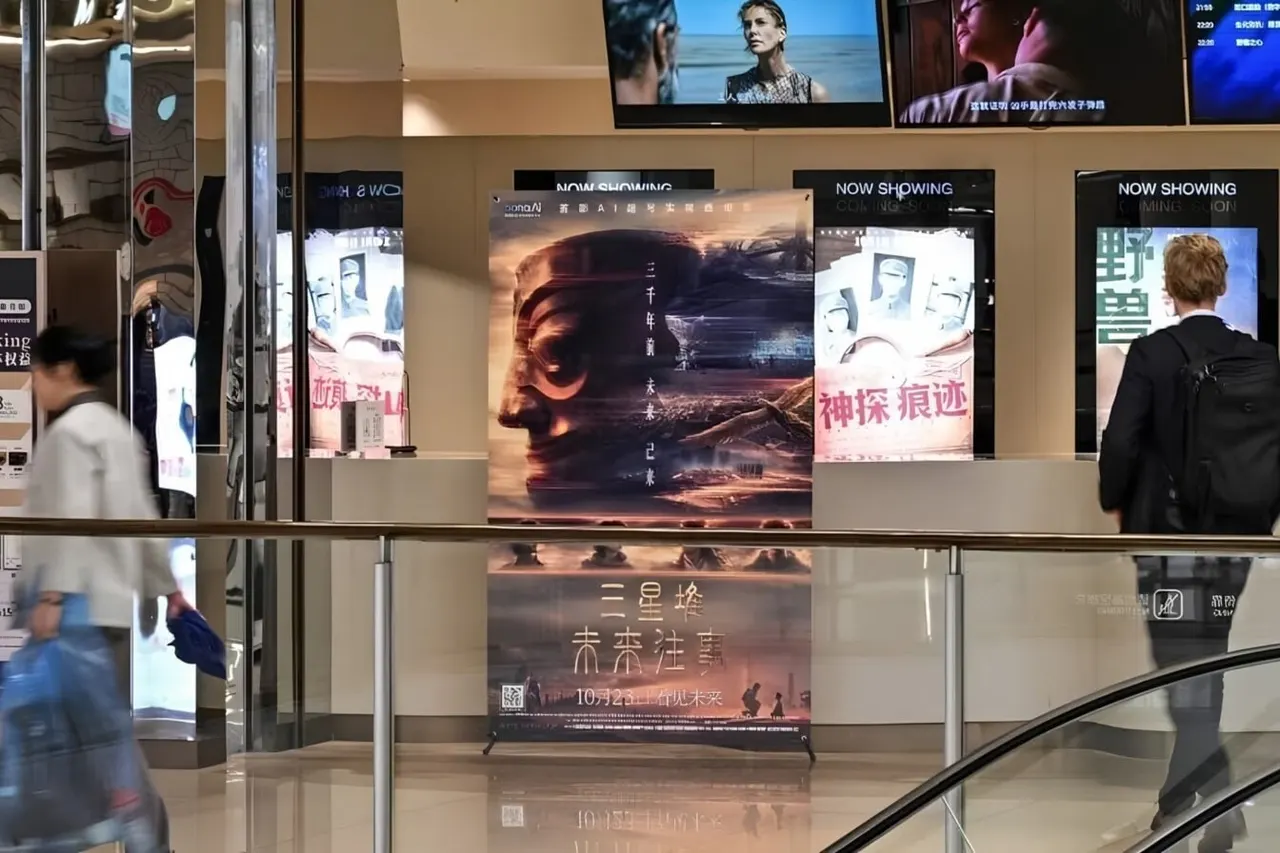
Sanxingdui: Future Past, billed as China's first feature-length film generated entirely by artificial intelligence, has stumbled at the box office. Released on 23 October, it took in only 1.21 million yuan (about 145,000 euros) over its first four days.
The film is adapted from a short series that has gathered more than 200 million views since July 2024. Its world draws on the ruins of Sanxingdui, the Sichuan archaeological site known for its bronze masks. The source is a booming genre: in September, AI-generated mini-series passed 200 billion views on Douyin, the Chinese version of TikTok.
Big launch, small returns
Bona Film Group, co-producer of The Battle at Lake Changjin, once China's biggest box-office hit, scheduled more than 10,000 screenings on day one, a number typical of a blockbuster. Presales nevertheless peaked at 80,000 yuan, around 9,700 euros.
The budget exceeds 10 million yuan, roughly 1.2 million euros. Nearly 100 people worked on the project for over two years, producing 1.2 million images and more than a hundred complete versions of the film. Studio head Jiang Defu himself acknowledges a lukewarm reception. By comparison, Niu Lai, an animated film with a deliberately rudimentary look released at the same time, has earned 64.29 million yuan, about fifty times as much. Chinese cinemas, in other words, are far from empty.
Why phone hits don't fill theatres
The gap comes first from the business model. On Douyin, generated mini-series are free and consumed in episodes of a few minutes between other videos. In a cinema, the same universe demands a ticket, a trip and sustained attention, in a format that magnifies every generation flaw. A feature exposes faces and movements that image generation still struggles to keep consistent over time, while short formats hide the seams.
The industry was watching the release as a real-world test. If the trend holds, the loss would approach 9 million yuan. A US specialist in Chinese cinema expects it to make would-be makers of fully generated features think twice. The film will get a second chance abroad, with a release in Malaysia planned for 12 November.
More from this day
See all →
Command & Conquer: Red Alert Turns 30 and Remains a Cult Classic

Ather Energy Surges 26.8% as CarTrade Drops 22% in Tech Stocks

TVS Capital Launches TVS Alts, a Rs 750 Crore Private-Credit Platform

Desible.ai founders on selling voice AI to Indian banks and insurers
More in: AI
See all →
Google Gemini Lets Friends Appear Together in AI Avatar Videos

Wikimedia Weighs In on New York Times Lawsuit Against OpenAI

Elon Musk Says Saving for Retirement Is Pointless as AI Advances