Russian text costs up to 1.5x more tokens in Claude than in GPT
A Russian developer measured 24 AI models. Russian costs 10-30% more tokens than English, but the gap between models is bigger: Claude uses 1.5x what GPT does.
 SUMO· the number puzzle
 Dialo· learn languages by speaking
 ediviewer· read EDI files like documents
 giftdetect· the right gift in minutes
Same meaning, same price per million tokens, and yet a page of Russian costs 54% more in Claude Sonnet 5.5 than in GPT-6.2 Sol. That is one result from a test of how many tokens Russian text eats in 24 models from 11 vendors.
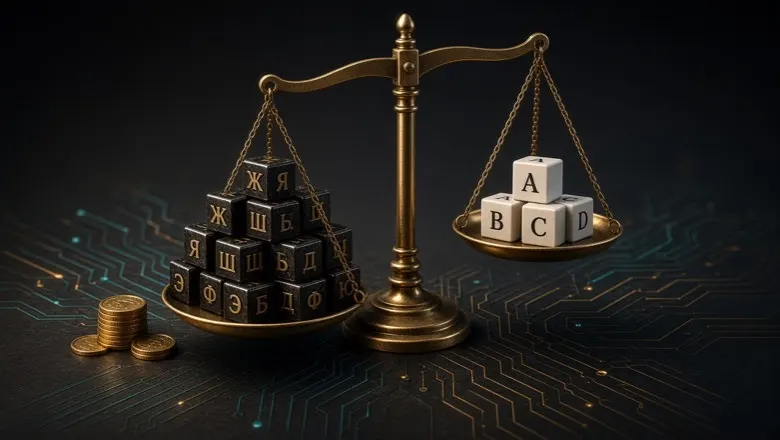
A token is the chunk of text a model actually reads and bills for. A tokenizer, the program that cuts text into those chunks, learns the common pieces from a big text collection. If that collection was mostly English, "information" becomes one token, while the Russian "информация" may split into two or three. More tokens means a higher bill, less room in the context window and slower output.
How big is the Russian token tax?
For ordinary text in most modern models, Russian runs 10-30% longer than English for the same meaning. The author sent six Russian and English pairs to each model as normal chat requests and read the input token count from the usage field, which is the number that gets billed. Chat template overhead, 1 to 30 tokens, was measured and subtracted.
Python and JSON barely suffer, since keys and syntax are English. Casual chat is cheaper than formal prose. The worst case is 1C code, a Russian-language business programming language with long words like УстановитьПараметр: Russian is 1.66 times longer than English in GPT and 2 times in Kimi. YandexGPT is the only model where Russian comes out shorter than English.
Did Claude fix it?
On paper, yes. The Russian/English ratio in Claude dropped from 1.73 in Sonnet 4.5 to 1.26 in models from 4.7 onward. But Russian token counts barely moved (+0.2%). English grew by 37%. Anthropic says the new tokenizer gives about 30% more tokens for the same text. That holds for English, not for Russian.
In both old and new versions, Claude spends about 1.5 times more tokens on Russian than GPT. For 1,000 pages of 1,800 characters, output costs $7.17 in Sonnet 5.5 and $4.66 in GPT-6.2 Sol, despite identical prices of $2 input and $10 output per million tokens.
Kimi K3 is the other outlier: Russian costs $10.48 against $5.62 for English. Prices come from vendor pages on 28 November 2026, standard rates, no caching or batch discounts.
Apps worth a look
SUMO: the number puzzleTap the right tiles, add them up, hit the target. Easy to learn, hard to master. Free, for all ages.
Dialo: learn languages by speakingTalk to an AI conversation partner; every sentence comes back corrected and explained in your language. 9 languages, A1 to C2.
ediviewer: read EDI files like documentsOpen EDIFACT and X12 messages, see every segment explained, convert to JSON/XML, export PDF and Excel. Runs locally, no upload.
giftdetect: the right gift in minutesPick who it is for, the occasion and their personality. The search engine reads product descriptions from local shops and ranks what fits. Free, no sign-up.
More from this day
See all →
NVIDIA GB300 rack found at Chinese data center tied to Alice Huang
Dark matter periodic table: physicists imagine dark atoms

Flipkart CEO Exit: Walmart's Chris Nicholas to Meet Staff Monday