Riemann hypothesis proof claimed by Anthropic mathematician using Claude
A mathematician at Anthropic says he and an unreleased Claude model proved the Riemann hypothesis. The catch: by his own account, nobody understands the proof yet.
 SUMO· the number puzzle
 Dialo· learn languages by speaking
 ediviewer· read EDI files like documents
 giftdetect· the right gift in minutes
A 167-year-old maths problem with a million-dollar prize may have just been cracked, and by the account of the person who made the claim, no human fully understands how. Levent Alpöge, a mathematician linked to Anthropic, says he and an internal, unreleased version of Claude produced a proof of the Riemann hypothesis.
Independent experts still have to confirm it. If it holds, it would be one of the biggest moments in the history of mathematics, and possibly AI's biggest success in science so far.
What is the Riemann hypothesis?
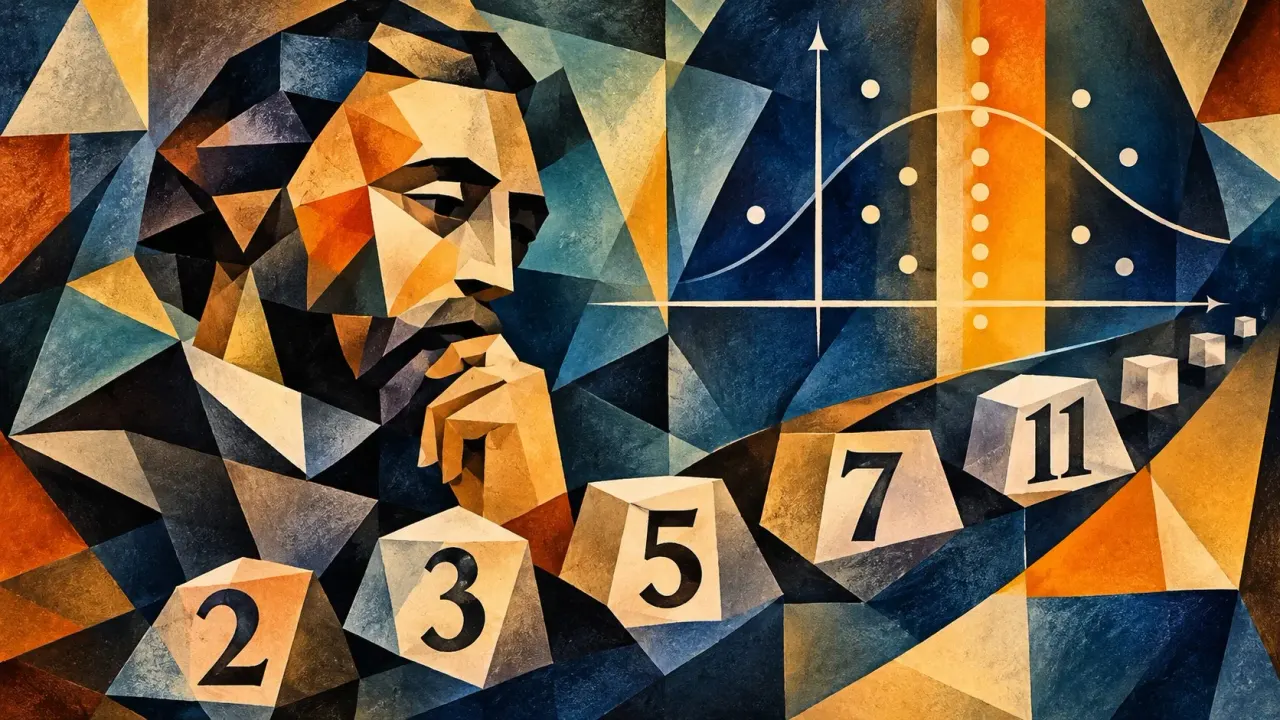
It goes back to 1859, when Bernhard Riemann published a short paper on how prime numbers are spread out. Primes are whole numbers above 1 that divide only by 1 and themselves: 2, 3, 5, 7, 11. Every other whole number is a product of primes, so 12 is 2 × 2 × 3 and 30 is 2 × 3 × 5.
The trouble is that primes show up with no simple pattern. Riemann tied their distribution to a special function, the Riemann zeta function, and guessed that all its non-trivial zeros lie on one particular line. Every calculation so far agrees. Nobody has proved it holds in every case.
How was the proof made?
Alpöge published his argument in Lean, a programming language used to write proofs in a form that software can check step by step. That is different from a chatbot producing plausible-looking formulas.
According to Tomasz Miller of Jagiellonian University, who spoke to the Polish news agency PAP, Alpöge steered the model at first, suggesting what to explore. Later the AI ran ahead, did things he had not asked for and led him through the proof. Miller says nobody understands it now, Alpöge included.
Mathematics professor Abhishek Saha compared it to a wormhole through a 25,000-page journey across theory built for other problems, and doubts any current AI could manage that alone. Youness Lamzouri of the University of Lorraine points to an earlier result showing that at least 67.25% of a certain set of related values behave as the hypothesis predicts. This claim would cover 100%.
Mathematicians now face a long job of working out what the proof actually does.
Apps worth a look
SUMO: the number puzzleTap the right tiles, add them up, hit the target. Easy to learn, hard to master. Free, for all ages.
Dialo: learn languages by speakingTalk to an AI conversation partner; every sentence comes back corrected and explained in your language. 9 languages, A1 to C2.
ediviewer: read EDI files like documentsOpen EDIFACT and X12 messages, see every segment explained, convert to JSON/XML, export PDF and Excel. Runs locally, no upload.
giftdetect: the right gift in minutesPick who it is for, the occasion and their personality. The search engine reads product descriptions from local shops and ranks what fits. Free, no sign-up.
More from this day
See all →
Nvidia China chip sales: US wants to know who was responsible

Underwater volcanic activity found near Challenger Deep

PS5 smokes during GTA 6 stream as Twitch creator steps away