Riemann hypothesis proof: why the 250,000 pages were a joke
Anthropic mathematician Alpöge says the 250,000-page Riemann hypothesis proof was partly a gag. His explanation confused people almost as much as the number did.
 SUMO· the number puzzle
 Dialo· learn languages by speaking
 ediviewer· read EDI files like documents
 giftdetect· the right gift in minutes
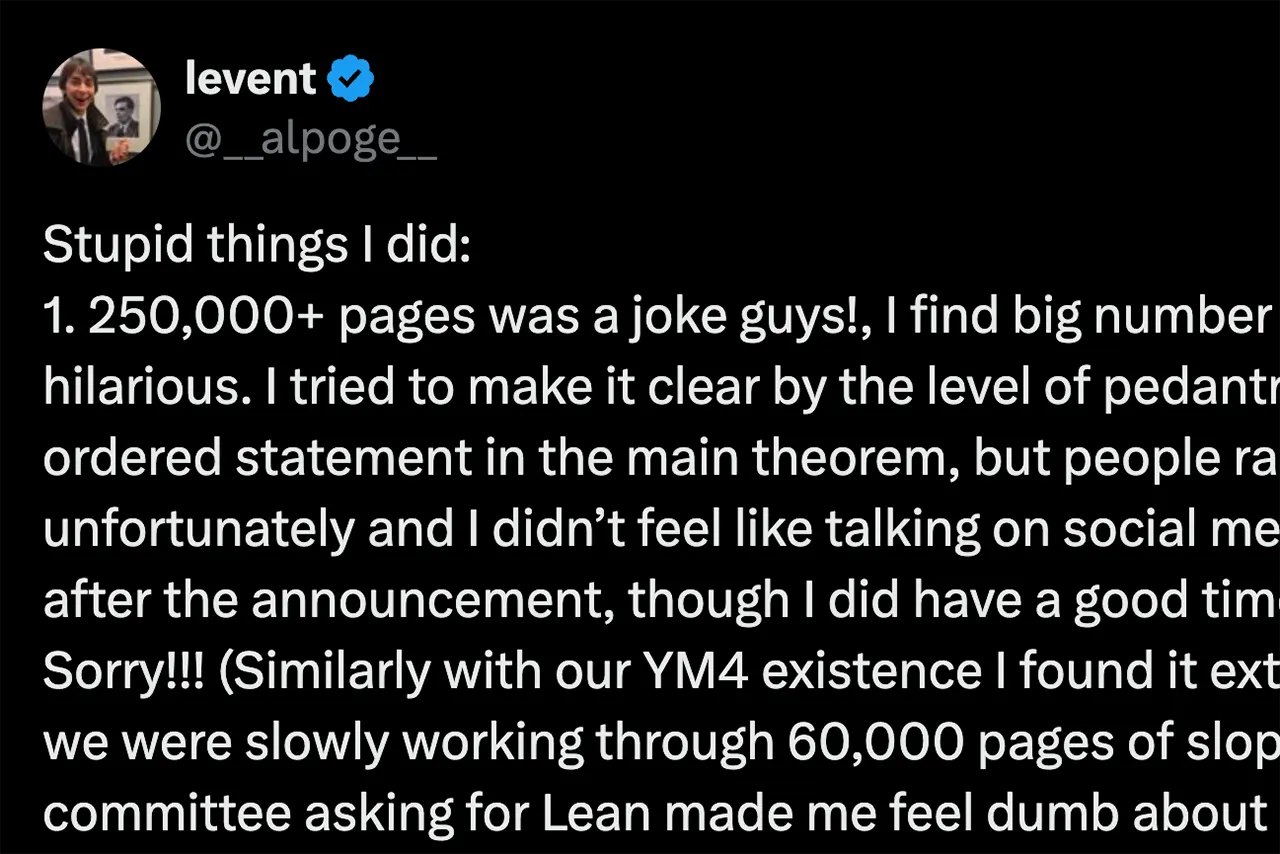
The Riemann hypothesis proof that supposedly ran past 250,000 pages? The man behind it now says that number was a joke. Anthropic mathematician Alpöge posted the explanation on X on 24 November (Japan time), and it needed some decoding.
The figure comes from a footnote on page 2 of the PDF in which Alpöge announced he had found a proof of the Riemann hypothesis together with Claude. The footnote says that he "of course amused myself" by going past 250,000 pages, and that Claude cutely called the result a "book" on the generalized Riemann hypothesis.
The point, as he now explains it, is that the length was padding. The text starts from the obvious: real numbers are ordered, so if sigma is not equal to 1/2, it is either bigger or smaller than 1/2. He says that level of pedantry in the main theorem was meant to signal the joke. People ran with the number anyway. Alpöge writes that he finds big numbers "extremely hilarious".
What does it mean for the proof?
The core of the proof is written in Lean, a programming language used to check mathematical proofs by computer. The 250,000-page natural-language version may not be needed at all. Alpöge admits the Lean code is "full of garbage" but compiles, and says criticism of it is reasonable. Checking efforts are continuing in several places.
He also joked about another project, an existence proof for four-dimensional Yang-Mills theory, where he slowly worked through 60,000 pages of AI-generated "slop".
Why did he do it?
Alpöge says he did not want a sloppy AI write-up attached to such a famous problem, and doubted he could produce anything readable, so he went for length. He cites advice from Terence Tao not to put jokes in papers, and says he now understands why. Tao has said an adviser once told him a paper lasts 30 years and a joke might not.
He also stresses what he considers the real point: these arguments are raw inputs for finding better definitions, and a difficult Riemann hypothesis would suggest the current setup is simply clumsy.
Apps worth a look
SUMO: the number puzzleTap the right tiles, add them up, hit the target. Easy to learn, hard to master. Free, for all ages.
Dialo: learn languages by speakingTalk to an AI conversation partner; every sentence comes back corrected and explained in your language. 9 languages, A1 to C2.
ediviewer: read EDI files like documentsOpen EDIFACT and X12 messages, see every segment explained, convert to JSON/XML, export PDF and Excel. Runs locally, no upload.
giftdetect: the right gift in minutesPick who it is for, the occasion and their personality. The search engine reads product descriptions from local shops and ranks what fits. Free, no sign-up.
More from this day
See all →
Meta Muse Charm price: the AI keychain reportedly costs $300

Waymo robotaxis pulled off freeways after California DMV order
AI crawlers on your site: GPTBot, ClaudeBot and what to block