Red Atlas: a free map of which hosts are reachable from Russia
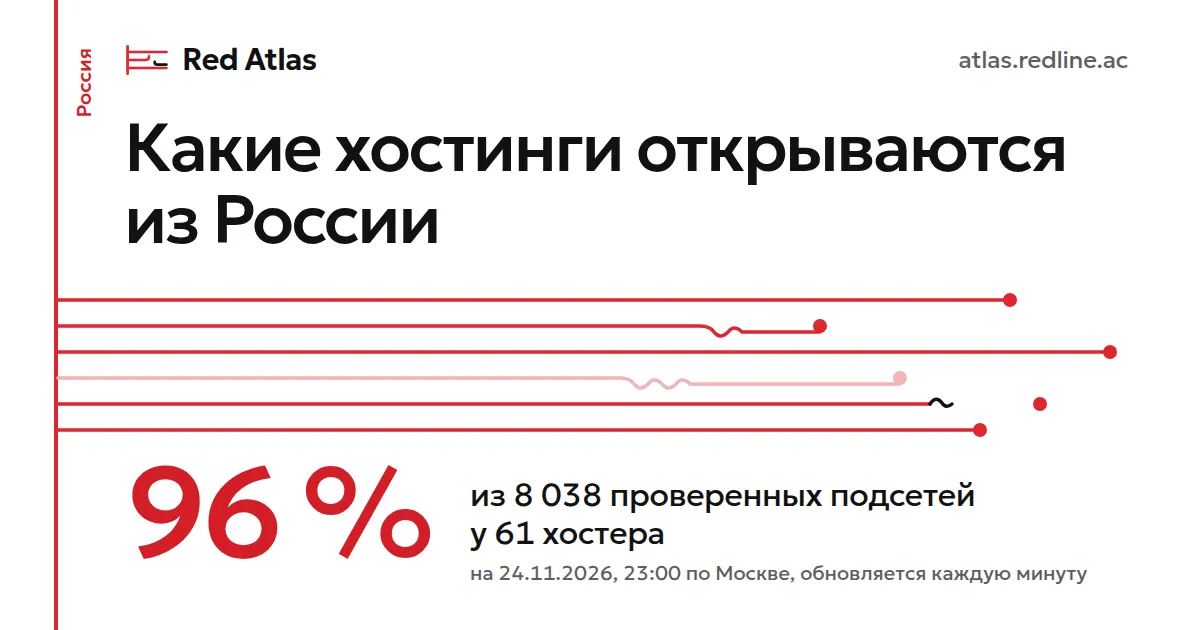
Red Atlas is a free map that checks which hosting subnets open from Russia. On 24 November, 96% of 8,038 checked subnets did, and the team admits an early bug.
 SUMO· the number puzzle
 Dialo· learn languages by speaking
 ediviewer· read EDI files like documents
 giftdetect· the right gift in minutes
Choosing a server abroad is mostly guesswork if your users are in Russia. The price list tells you nothing about whether the server will open for them. Red Atlas, a free map launched a few days ago, tries to answer that.
It currently covers 77 hosting providers and 65,998 /24 subnets (blocks of 256 addresses). On 24 November 2026, around 23:15 Moscow time, 96% of 8,038 checked subnets across 61 providers opened from Russia. The rest were fully closed, partly closed, or visible only from some networks. The map refreshes every minute, and everything on the site is available as JSON without a key, at 120 requests per minute per address.
The team also owns up to a mistake. Early on, the map showed Selectel with 63-67% of subnets open, when over 95% actually were. The fault was in the team's methodology, not at Selectel.
How does Red Atlas check if a server is reachable from Russia?
One vantage point is not enough, since a Moscow data centre sees something different from a home connection in Novosibirsk. Red Atlas uses Globalping and RIPE Atlas probes in Russian data centres and in home networks across regions. Those two types set a subnet's colour.
If an address stays silent from Russia, a control point in Frankfurt is asked. If it answers, the server is alive and something blocks the route. If Frankfurt is silent too, the server is probably down, and it is not called a block. An address counts as closed only after a second control point in the Netherlands also fails to see it.
Reachability is decided by a real connection, not a ping: a TCP connection plus a TLS handshake, or an SSH key exchange if there is no TLS. Ping only hints that an address is alive.
What do the five statuses mean?
There are five: open from Russia, open from not all networks, individual addresses closed, blocked in Russia (at least two checked addresses closed, open from Europe), and not working anywhere.
You can also paste your own IP, IP:port, site or hosting name into search. A few seconds later you see three Russian networks and Frankfurt as a control. Per-subnet pages show which networks failed and what came back, for example a connection that works until TLS is cut.
The filters cover server country, price and payment method (SBP, card, crypto). Providers cannot pay for placement. Sponsors sit in a separate block and do not change rankings. Mobile operators will get their own column later.
Apps worth a look
SUMO: the number puzzleTap the right tiles, add them up, hit the target. Easy to learn, hard to master. Free, for all ages.
Dialo: learn languages by speakingTalk to an AI conversation partner; every sentence comes back corrected and explained in your language. 9 languages, A1 to C2.
ediviewer: read EDI files like documentsOpen EDIFACT and X12 messages, see every segment explained, convert to JSON/XML, export PDF and Excel. Runs locally, no upload.
giftdetect: the right gift in minutesPick who it is for, the occasion and their personality. The search engine reads product descriptions from local shops and ranks what fits. Free, no sign-up.
More from this day
See all →



More in: Web & Dev
See all →
Vinted PS5 listings that only sell a photo of the console

Kagi Mail beta: an ad-free Gmail alternative from Kagi

TikTok down: outage hit feeds, search and profiles worldwide