POSTECH and Samsung Research Build AR Glasses Bright Outdoors
POSTECH and Samsung Research have developed a 1.5 mm metasurface waveguide for AR glasses that stays bright outdoors and tolerates eye movement, published in Nature.
 SUMO· the number puzzle
 Dialo· learn languages by speaking
 ediviewer· read EDI files like documents
 giftdetect· the right gift in minutes
A team from South Korea's POSTECH and Samsung Research has developed an optical system for augmented reality glasses that keeps images bright and legible even outdoors. The Ministry of Science and ICT announced the work on November 11, and the results were published in the journal Nature on November 12 (KST).
The group, led by Professor Junsuk Rho of POSTECH's mechanical engineering department, cut light loss inside a metasurface waveguide. The result is a bright image that holds up even when the wearer's eye shifts.
Why AR glasses struggle
Conventional AR glasses send light from a tiny display into a thin waveguide, where surface microstructures redirect it toward the eye. Some of that light escapes in other directions, lowering brightness, and the loss grows as the field of view widens. Narrow viewing angles, low brightness and thickness are among the long-standing complaints, along with weight, battery life and heat.
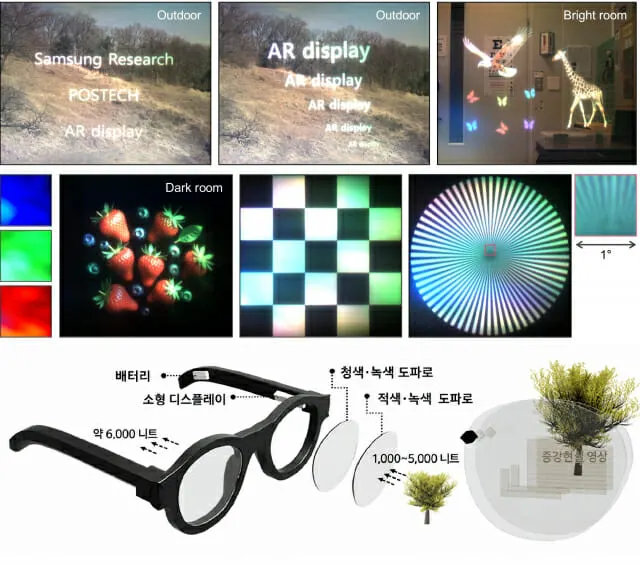
The researchers arranged nanostructures smaller than the wavelength of light on the waveguide surface. Their shape and spacing vary by position, so the light's direction is controlled according to where and at what angle it enters. For full color, they combined one layer carrying mainly blue and green with another carrying mainly red and green. Each layer uses a silicon nitride (SiNx) metasurface with 29 differently designed nanostructure regions.
Measured results
According to Rho, the optics are 1.5 mm thick in total and offer a 30-degree diagonal field of view. With 15 mm between eye and waveguide, the eyebox measures 8 mm by 8 mm. Across eye positions, white-light luminance efficiency at the image center averaged 1,938 nits/lm and peaked at 4,225 nits/lm. Average efficiency for red, green and blue was 1,897, 1,977 and 2,170 nits/lm, which the team calls relatively balanced.
In indoor and outdoor shots, the prototype showed white text in bright outdoor light and color images indoors with display output cut to 30%.
Next steps
Rho said improving image quality so small text is easier to read in bright sunlight remains a follow-up task. He added that scaling production to large-area nanoimprint processes could replicate the nanostructures precisely over wide areas, lowering costs and raising productivity.
Apps worth a look
SUMO: the number puzzleTap the right tiles, add them up, hit the target. Easy to learn, hard to master. Free, for all ages.
Dialo: learn languages by speakingTalk to an AI conversation partner; every sentence comes back corrected and explained in your language. 9 languages, A1 to C2.
ediviewer: read EDI files like documentsOpen EDIFACT and X12 messages, see every segment explained, convert to JSON/XML, export PDF and Excel. Runs locally, no upload.
giftdetect: the right gift in minutesPick who it is for, the occasion and their personality. The search engine reads product descriptions from local shops and ranks what fits. Free, no sign-up.
More from this day
See all →
Humanoid Robot Kestrel Quits Antarctic Ice Ultra After 3 km

BigTechPlus Launches HomeQ Mobile Notices via KakaoTalk
Northzone launches Northstars network of 25 European tech operators