Phobos 2 last photo: the cigar-shaped shadow near Mars, explained
Soviet probe Phobos 2 sent back a strange cigar-shaped shape before it went silent in 1989. It was a shadow, and the real cause of the failure is more mundane.
 SUMO· the number puzzle
 Dialo· learn languages by speaking
 ediviewer· read EDI files like documents
 giftdetect· the right gift in minutes
A dark, elongated shape in one of the last pictures from the Soviet probe Phobos 2 has fed UFO theories for more than 37 years. The probe went silent near Mars in March 1989, and the odd streak looked like the perfect culprit.
Phobos 2 launched on 12 July 1988 on a Proton rocket from the Baikonur cosmodrome. Its job was to study Mars and its moon Phobos, take detailed pictures of both and run experiments on the planet's environment. It reached Mars orbit on 30 January 1989 and sent back useful data, including more than 30 images of Phobos, despite control system problems from the start. Its sister probe, Phobos 1, had already been lost in September 1988 after a wrong command was sent from the ground.
On 27 March 1989, Phobos 2 turned its communication antennas away from Earth to prepare navigation photos of Phobos. Ground controllers never got contact back. Some patchy radio signals arrived over the following hours, but engineers could not regain control. A few of the last images did make it home.
Was the Phobos 2 shadow an alien spacecraft?
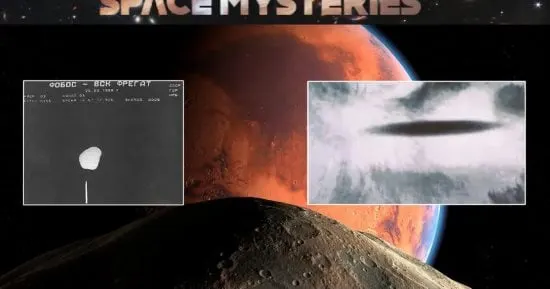
One image showed a long shadow that looked like a cylinder near the Martian surface. In 1991, Marina Popovich, a former Soviet test pilot and the first Soviet woman to break the sound barrier, held a press conference at the Soviet consulate in San Francisco. She said the pictures showed a cigar-shaped object near Phobos and suggested it could be an alien mothership.
The science says otherwise. A NASA-led study in 1991 found that the probe and Phobos were moving in very close orbits at similar speeds. That let the Termoskan multispectral camera capture the moon's own shadow on Mars, which appeared as a dark, cigar-like streak. The angle of the shadow, the camera's pointing, the probe's slight wobble and the way the scanner works all played a part. Europe's Mars Express took similar shadow images in 2005.
Why did Phobos 2 stop working?
The likeliest cause is a fault in the computers that controlled the craft's orientation. One of its three processors had been misbehaving since arrival at Mars, and when another failed, the remaining one could not steer alone. The batteries may also have run down if the solar panels stopped facing the Sun while the craft tumbled.
The mission ended before reaching all its goals. Even so, Phobos 1 and 2 together gathered more data on Mars and its moon than earlier Soviet missions combined.
Apps worth a look
SUMO: the number puzzleTap the right tiles, add them up, hit the target. Easy to learn, hard to master. Free, for all ages.
Dialo: learn languages by speakingTalk to an AI conversation partner; every sentence comes back corrected and explained in your language. 9 languages, A1 to C2.
ediviewer: read EDI files like documentsOpen EDIFACT and X12 messages, see every segment explained, convert to JSON/XML, export PDF and Excel. Runs locally, no upload.
giftdetect: the right gift in minutesPick who it is for, the occasion and their personality. The search engine reads product descriptions from local shops and ranks what fits. Free, no sign-up.
More from this day
See all →
JioAstro: Jio's AI Vedic astrology platform takes on Astrotalk

One UI 9.0 battery drain: Samsung moderator promises a fix
WhatsApp scheduled messages finally arrive, up to two weeks ahead

Mozilla Firefox on iPhone: 55,000 firms ask the EU to act on Apple
More in: Space
See all →
Voyager 1 stops sending data just as it hits one light-day away
NASA Perseverance and Odyssey Mars missions paused by faults
Pakistani astronaut Muhammad Zeeshan Ali heads to China's Tiangong station