Pentagon freezer hack warning: AI agents will check military sites
After a hack of supermarket freezers in France, the Pentagon's CIO calls it a wake-up call and is sending swarms of AI agents to inspect military infrastructure.
 SUMO· the number puzzle
 Dialo· learn languages by speaking
 ediviewer· read EDI files like documents
 giftdetect· the right gift in minutes
A hacked supermarket freezer sounds like a nuisance. The Pentagon's chief information officer, Kirsten Davis, sees something else: a warning for the whole of society, and a reason to start sending AI agents through military infrastructure.
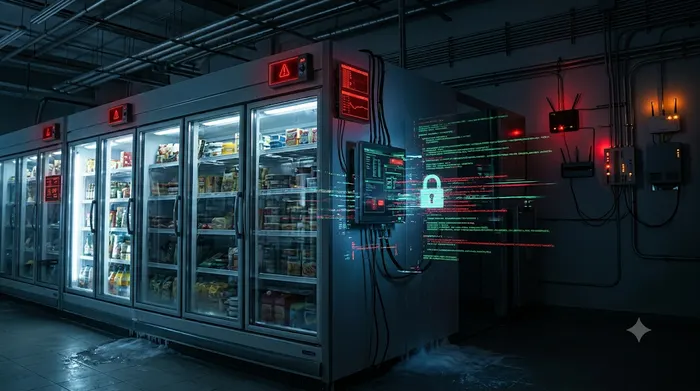
Davis called the freezer hacks in Europe a "wake-up call for society as a whole," according to remarks reported on Thursday. France recently blamed Iran's Revolutionary Guard for a cyberattack last month on the refrigeration systems of about 700 French shops. Earlier this month, the cooling equipment at a French blood bank was hit too. An early warning system caught it, and no stored blood products were damaged.
What is operational technology, and why is it exposed?
Operational technology (OT) is the software and hardware that controls physical equipment in industrial processes and infrastructure. Davis said hacking it is "surprisingly easy" and that attacks can cause real physical damage. Blood banks, plasma and organ storage, and food production and transport all depend on refrigeration and could be targeted the same way.
The military is not exempt. It relies on civilian power, water and fuel systems, and on blood banks to treat wounded troops. Ships, submarines, aircraft, their software and weapons systems could also be affected by similar attacks, Davis said.
There is a US incident too. In August, freezers at commissary stores on six military bases broke down at around the same time. Military investigators are looking into it, and no hack has been officially confirmed.
How is the Pentagon using AI to check its systems?
Beyond basic cyber hygiene, the department is using an "agent swarm," a group of AI agents that cooperate on a task, to survey the state and weak points of key military infrastructure. The idea is that AI can help cover a huge number of facilities and machines.
The agents carry their own risk, so the Pentagon is cautious. Davis said they are programmed "very carefully," given safeguards and tested first in a sandbox, an isolated environment where mistakes cannot touch real systems.
Apps worth a look
SUMO: the number puzzleTap the right tiles, add them up, hit the target. Easy to learn, hard to master. Free, for all ages.
Dialo: learn languages by speakingTalk to an AI conversation partner; every sentence comes back corrected and explained in your language. 9 languages, A1 to C2.
ediviewer: read EDI files like documentsOpen EDIFACT and X12 messages, see every segment explained, convert to JSON/XML, export PDF and Excel. Runs locally, no upload.
giftdetect: the right gift in minutesPick who it is for, the occasion and their personality. The search engine reads product descriptions from local shops and ranks what fits. Free, no sign-up.
More from this day
See all →
iPhone worse_query flaw: Binance warns crypto seed phrases at risk

Telegram's Pavel Durov jokes about honeytrap spies, draws backlash

Huawei Qingyun HM650: a desktop PC built with 100% Chinese parts