Passkey security study: none of 103 tested sites passed every check
Researchers in Germany attacked 103 websites that support passkeys. Not one met every WebAuthn security requirement, and 18 had critical flaws.
 SUMO· the number puzzle
 Dialo· learn languages by speaking
 ediviewer· read EDI files like documents
 giftdetect· the right gift in minutes
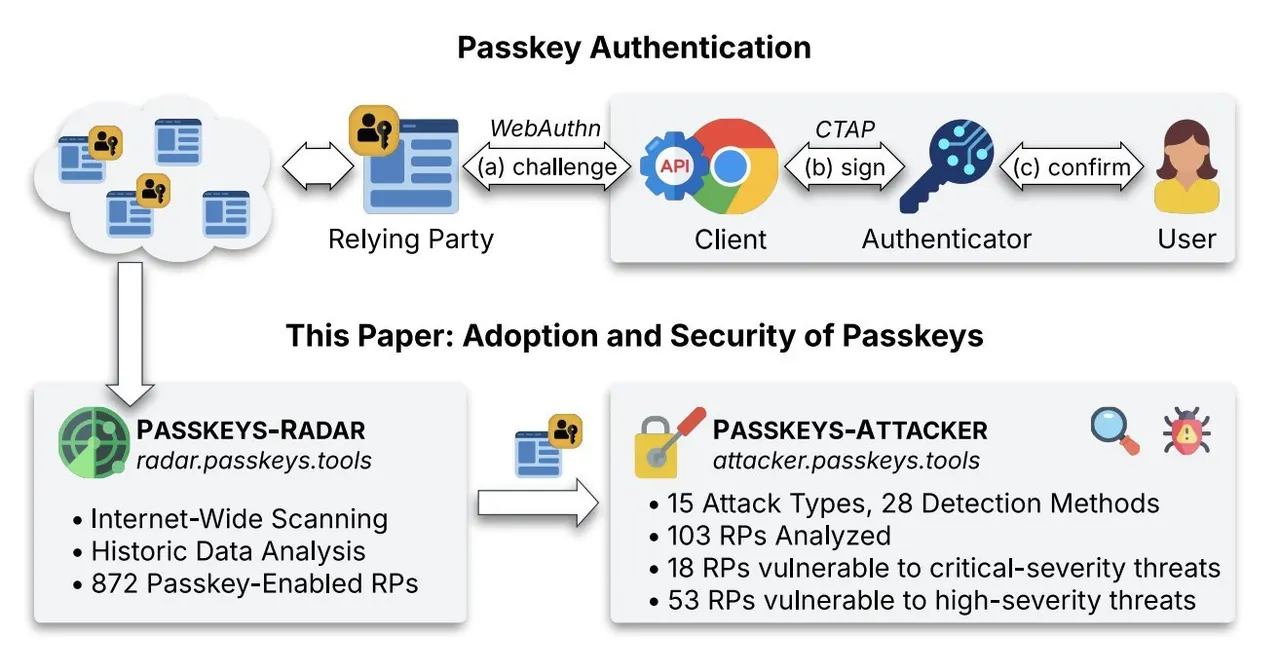
Passkeys are sold as the safer replacement for passwords. A new study from researchers at Ruhr University Bochum and colleagues suggests that many websites haven't built them safely yet: of 103 passkey sites put under attack, none passed every security requirement of the WebAuthn standard.
The paper is called "The State of Passkeys: Studying the Adoption and Security of Passkeys on the Web" and was presented at the USENIX Security Symposium. A passkey replaces the password with public-key cryptography plus a fingerprint, face scan or PIN on your phone or computer.
How the researchers tested passkey sites
The team first built a detection system, PASSKEYS-RADAR, which found 872 sites that support passkeys. They could actually register a passkey on 208 of them, and the basic setup already looked shaky. Only 34% (71 sites) asked for extra verification, such as re-entering the password, before adding a passkey. The other 66% allowed it immediately. Some sites had no way to delete a passkey, which matters if you lose a device, and 25 sites refused to let users register several passkeys as a backup. Almost all requested outdated cryptographic algorithms, and 38% (80 sites) applied the passkey to the whole parent domain, which exposes them to subdomain takeover.
Then came a second tool, PASSKEYS-ATTACKER, which alters WebAuthn messages. Using 15 attack methods against 103 sites, the team found critical flaws on 18 and important ones on 53.
What went wrong on the worst sites
Five sites never verified the cryptographic signature, the core of how a passkey works. Tampered data could log an attacker into someone else's account. Fourteen sites were vulnerable to attacks that abuse duplicate credential IDs. An attacker could overwrite a victim's public key and lock them out (5 sites), or delete the victim's passkey (3 sites). With the victim's public key in hand, three sites could even be tricked into logging the victim into the attacker's account.
One case involved a list of domains allowed to share passkeys. It contained a domain anyone could register for 10 euros a year. Whoever bought it could have taken over accounts on 72 related sites.
The passkey idea itself isn't what failed. The weak spots were in how individual sites implemented it.
Apps worth a look
SUMO: the number puzzleTap the right tiles, add them up, hit the target. Easy to learn, hard to master. Free, for all ages.
Dialo: learn languages by speakingTalk to an AI conversation partner; every sentence comes back corrected and explained in your language. 9 languages, A1 to C2.
ediviewer: read EDI files like documentsOpen EDIFACT and X12 messages, see every segment explained, convert to JSON/XML, export PDF and Excel. Runs locally, no upload.
giftdetect: the right gift in minutesPick who it is for, the occasion and their personality. The search engine reads product descriptions from local shops and ranks what fits. Free, no sign-up.
More from this day
See all →
Comet 220P/McNaught suddenly got 1,000 times brighter. Here's why

Coral Hart used AI to write 370 books in 20 months

WhatsApp Zaps: self-deleting photos and videos for any chat

Green SM taxis: Karnataka halts new registrations, eyes mandatory meters
More in: Security
See all →
NoisyTCP Linux bug can crash a server remotely, no login needed

Artex AI hacking tool: FBI says it breaches networks in under three hours

Estonia's digital exile government: running the state from abroad