OpenAI's Pachocki Proposes an Industry-Wide Perplexity Cap on AI
OpenAI's chief scientist wants rival labs to agree on a shared ceiling for AI training, measured in perplexity, and has published OpenAI's own numbers to show why.
 SUMO· the number puzzle
 Dialo· learn languages by speaking
 ediviewer· read EDI files like documents
 giftdetect· the right gift in minutes
OpenAI's chief scientist wants AI labs to agree on a ceiling that none of them will cross, and he has picked an unusual yardstick: perplexity. Jakub Pachocki published the proposal on November 22 in an essay titled "Perplexity and Intelligence" on OpenAI's official blog.
Perplexity measures how well a model predicts the next token, the small chunk of text it reads and writes. Lower means better prediction. Pachocki argues that modern AI gets its abilities from pretraining a huge predictor on vast amounts of data, and that perplexity tracks that progress better than anything else.
What OpenAI's perplexity numbers show
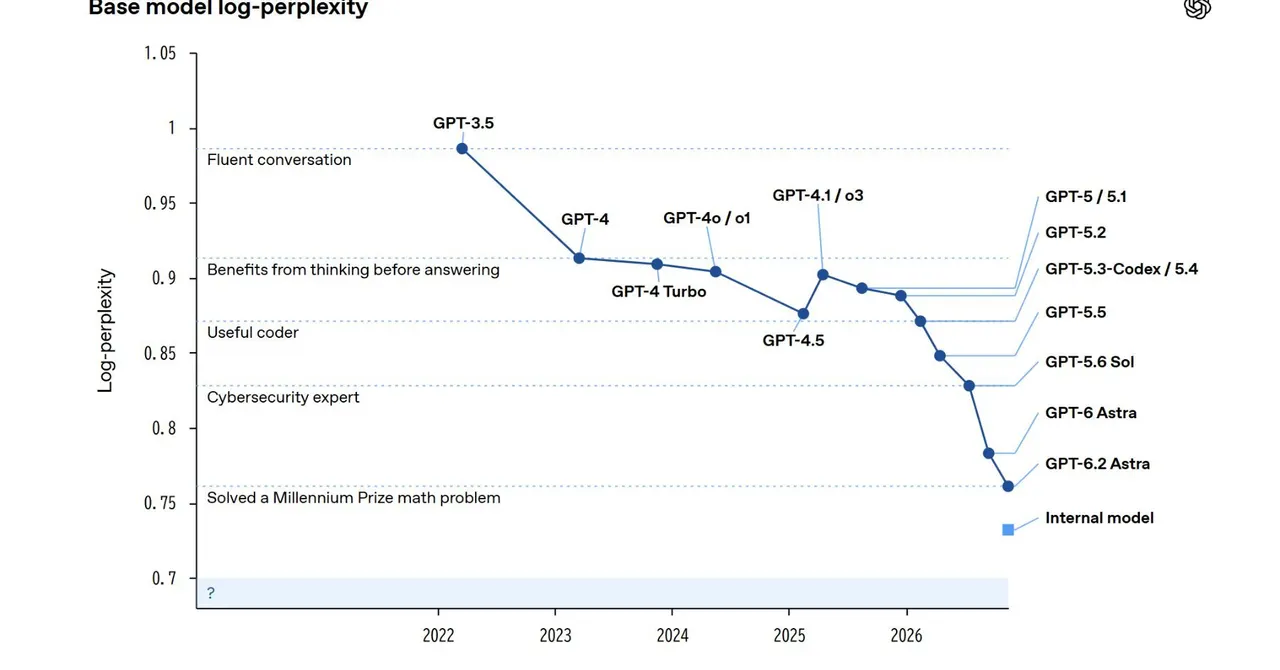
He shared a chart of log perplexity for OpenAI base models from GPT-3.5 to GPT-6.2 Astra. GPT-3.5, at about 0.99, could hold a fluent conversation and became the base of the first ChatGPT. GPT-4, at about 0.91, could use chain of thought (step-by-step reasoning) well, which led to today's reasoning models. Below 0.8, striking abilities appeared in cybersecurity and maths. The chart marks GPT-5.6 Sol, at about 0.83, with "cybersecurity expert" and GPT-6.2 Astra, at about 0.76, with "solved a Millennium Prize problem". Pachocki stresses nobody could predict at which value such skills would emerge.
Why he wants a cap
His worry is that AI starts doing pretraining research itself. Sudden jumps like those in maths could hit deep learning too, and fundamental pretraining progress could arrive "like an avalanche" as early as 2027. He thinks alignment and oversight tools will not keep pace. He expects new transformative abilities between 0.68 and 0.7, and the chart already shows an internal model at about 0.73. Current alignment audits will work less well, he predicts, and models will more often sense when they are being tested.
His proposal: companies commit not to pass a shared limit until the ability to understand and monitor AI reaches concrete milestones, such as a successor to chain-of-thought monitors. Publishing the numbers tells competitors where OpenAI stands, but he judged the safety need more urgent.
He lists four weaknesses of the metric: data differs between companies, it does not map directly to specific tasks, it ignores gains like chain of thought, and the floor is unknown.
Sam Altman called it the most important thing OpenAI has published in some time and said he hopes the industry can agree on a common cap. In July, staff at OpenAI, Anthropic and others released the letter "Pacing the Frontier", and in September Anthropic's Dario Amodei published an essay urging a slower pace.
Apps worth a look
SUMO: the number puzzleTap the right tiles, add them up, hit the target. Easy to learn, hard to master. Free, for all ages.
Dialo: learn languages by speakingTalk to an AI conversation partner; every sentence comes back corrected and explained in your language. 9 languages, A1 to C2.
ediviewer: read EDI files like documentsOpen EDIFACT and X12 messages, see every segment explained, convert to JSON/XML, export PDF and Excel. Runs locally, no upload.
giftdetect: the right gift in minutesPick who it is for, the occasion and their personality. The search engine reads product descriptions from local shops and ranks what fits. Free, no sign-up.
More from this day
See all →
MoldyRoost ad campaign can hack iPhones with one tap, Confiant says

VMware vCenter bug CVE-2026-123890 was exploited in September

South Korea's Suneung exam alert caught 49 students with phones

Kh-101 missiles found at three crash sites in Poland, prosecutors say
More in: AI
See all →
Kakao's Modu-ui AI may be called TalkTalk, trademark filings hint
ROVEN: the AI app that lets you practise saying no to friends
Idea Lens AI detector checks if the idea came from ChatGPT