NTT Unveils Physical AI That Predicts Robot Failures in Advance
NTT has announced a physical AI technology that lets robots foresee risks such as falling or collapsing loads and pick the action most likely to succeed.
 SUMO· the number puzzle
 Dialo· learn languages by speaking
 ediviewer· read EDI files like documents
 giftdetect· the right gift in minutes
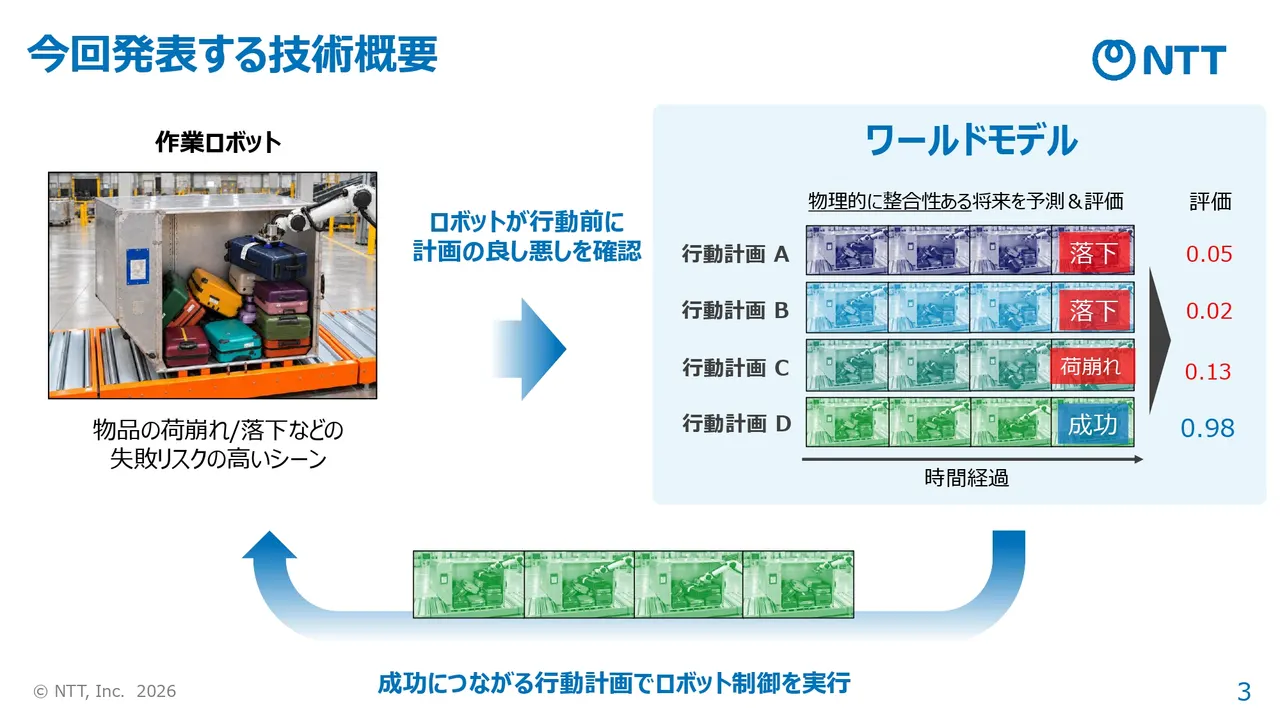
NTT announced on November 11 a physical AI technology that lets robots predict risks such as collapsing loads or dropped objects before they act, and then choose the action with the best chance of success. It is built on the "NTT World Model," which forecasts object motion according to the laws of physics and scores several candidate actions in advance.
Why conventional world models fall short
A world model grasps the state of the outside world and predicts how it will change as a result of the robot's own actions. Most existing versions learn empirically from huge amounts of video, and in situations they have not seen they can produce predictions that violate physics. That is a particular problem for airport baggage or parcels, where shape, weight and placement vary so widely that collecting training data for every case is hard.
The NTT World Model pairs a video generation model with a proprietary "physical control adapter." The adapter estimates each object's position, posture, speed and mass, then predicts changes using equations of motion, reproducing contacts and collisions between objects. According to NTT, combining the two suppresses unnatural outputs such as objects vanishing or deforming, and keeps predictions physically consistent even in untrained situations.
Results and next steps
The system works with existing robot control software. For multiple candidate actions generated by a VLA (Vision-Language-Action) model or a motion planner, it predicts the outcome as video and outputs a success score for each, so the robot can compare options before moving.
In an experiment stacking irregularly shaped objects on shelves with a small robot, pairing the open-source VLA model π0.5 with the NTT World Model raised the task success rate from 73.1% to 92.3%. On the public OBJ3D benchmark, which includes multi-object collisions, it scored 7.81 on LPIPS, a metric approximating human perception of similarity between real and predicted video. That beat the existing OCK method (7.92) and NVIDIA Cosmos Predict 2.5 (21.90), where lower is better.
NTT's first target is loading and unloading airport baggage of varying shapes and weights. It will run demonstrations with Mujin and aims to extend the technology to logistics and warehousing, manufacturing, construction and retail.
Apps worth a look
SUMO: the number puzzleTap the right tiles, add them up, hit the target. Easy to learn, hard to master. Free, for all ages.
Dialo: learn languages by speakingTalk to an AI conversation partner; every sentence comes back corrected and explained in your language. 9 languages, A1 to C2.
ediviewer: read EDI files like documentsOpen EDIFACT and X12 messages, see every segment explained, convert to JSON/XML, export PDF and Excel. Runs locally, no upload.
giftdetect: the right gift in minutesPick who it is for, the occasion and their personality. The search engine reads product descriptions from local shops and ranks what fits. Free, no sign-up.
More from this day
See all →
Google Wallet Adds Digital Home Keys for NFC and UWB Smart Locks

TSMC plans up to $1 billion investment in Anthropic and OpenAI

Acecore, Supplya and Navidyn Take Top Spots at TC Battlefield