Neiry pigeon drones: Russian firm takes orders for bird photography
Russian company Neiry now takes orders for aerial photos shot by pigeons with electrodes implanted in their brains. Prices start at 300,000 rubles per square kilometre.
 SUMO· the number puzzle
 Dialo· learn languages by speaking
 ediviewer· read EDI files like documents
 giftdetect· the right gift in minutes
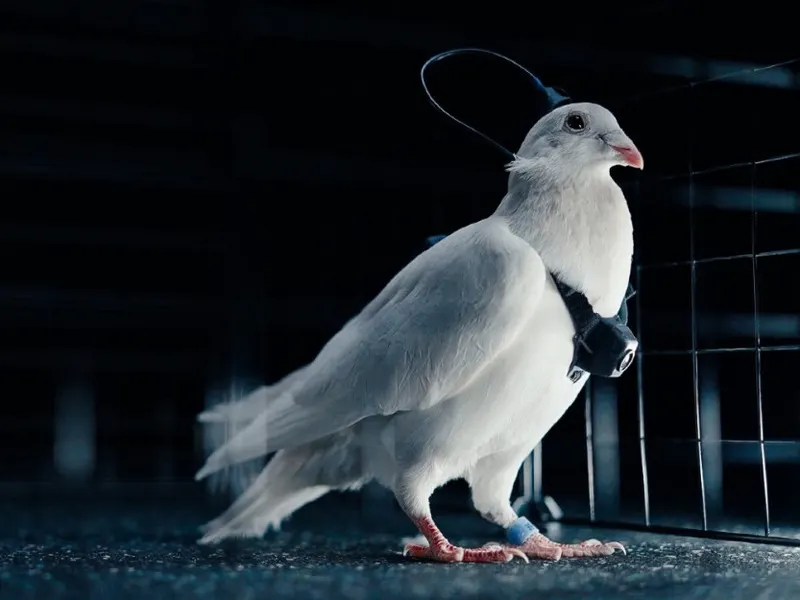
Hiring a pigeon to photograph your pipeline sounds like a joke. Russian company Neiry is now selling it as a service: aerial photography by pigeons with electrodes in their brains, steered remotely by an operator.
The service is still in test mode and only available in Russia. Shooting starts at 300,000 rubles per square kilometre. According to the company, its pigeons have flown more than 100 times outside the lab over the past year, taking over 1,000 photos. The longest flight ran past 10 hours, and the maximum control distance was over 100 km.
How do Neiry's pigeon biodrones work?
Biocompatible electrodes are implanted in the bird's brain and wired to a stimulator and controller in a small backpack. The operator uploads a route, and the system sends electrical impulses that nudge the pigeon in the right direction. Founder Alexander Panov says ordinary training isn't needed. The birds take off and land on command, gain altitude and perform other manoeuvres, all through the neural interface.
Neiry's pitch is endurance. Pigeons need no batteries for motors and can avoid obstacles on their own. The company also claims they can film in places where conventional drones are restricted. It says the cost is comparable to regular drone surveys.
What would the pigeons photograph?
Targets include power lines, pipelines, gas distribution nodes and city infrastructure, with environmental monitoring as another possibility. Before images reach a customer, AI blurs the faces of anyone caught in frame.
Is it legal and humane?
Neiry says it wrote to the environment and science ministries, an ecology institute and other bodies, and that the replies showed no conflict with current law. It has not offered independent confirmation that such flights need no extra permits. The company also says it follows an approved ethics protocol and aims for 100% survival after implantation, but it gave no detailed figures on post-surgery complications.
Neiry unveiled the first version, the PJN-1, in November 2025, when it was in flight testing. The company has also looked at neural interfaces for other birds, including crows to carry cargo and gulls to watch coastlines.
Apps worth a look
SUMO: the number puzzleTap the right tiles, add them up, hit the target. Easy to learn, hard to master. Free, for all ages.
Dialo: learn languages by speakingTalk to an AI conversation partner; every sentence comes back corrected and explained in your language. 9 languages, A1 to C2.
ediviewer: read EDI files like documentsOpen EDIFACT and X12 messages, see every segment explained, convert to JSON/XML, export PDF and Excel. Runs locally, no upload.
giftdetect: the right gift in minutesPick who it is for, the occasion and their personality. The search engine reads product descriptions from local shops and ranks what fits. Free, no sign-up.
More from this day
See all →
OUTSENSE origami engineering folds wood and metal to a tenth of the size

GTA VI PS5 leak: full game dump reaches torrent sites
University of Tokyo robot face has 65 artificial muscles