Kakao Open-Sources Kanana-2-v-Decide Multimodal Decision Model
Kakao has released Kanana-2-v-Decide on Hugging Face, a multimodal model that outputs structured decisions for AI agents, with responses in under 0.04 seconds.
 SUMO· the number puzzle
 Dialo· learn languages by speaking
 ediviewer· read EDI files like documents
 giftdetect· the right gift in minutes
Kakao has released Kanana-2-v-Decide, an in-house multimodal model for AI decision-making, as open source on Hugging Face, the company said on November 6. Unlike typical chatbots that write answers in sentences, the model returns its judgment in a fixed format, so it can slot into automated workflows.
Built on Kakao's earlier Kanana-2-v-3b, the model analyzes text and images together. Kakao points to uses such as sorting customer-service inquiries, identifying product photos and choosing which tool an AI agent should use. Results come in three forms: a probability that a condition holds, a choice among candidates made by comparing their probabilities, or a score that reflects the probabilities computed at each evaluation step.
In one example, a buyer asks for an exchange and attaches a photo of a damaged product. The model assesses whether the item is broken, what type of inquiry it is and the customer's sentiment. A service can then follow preset rules to explain exchange options or pass the case to a human agent.
Built for speed
To cut latency, the model converts questions and answer options into numeric vectors and compares them. Vectors for options can be stored and reused, which reduces computation when the same request recurs and suits tasks with many categories. According to Kakao, average response time on a single Nvidia H200 GPU was under 0.04 seconds, 43 times faster than GPT-6 Luna.
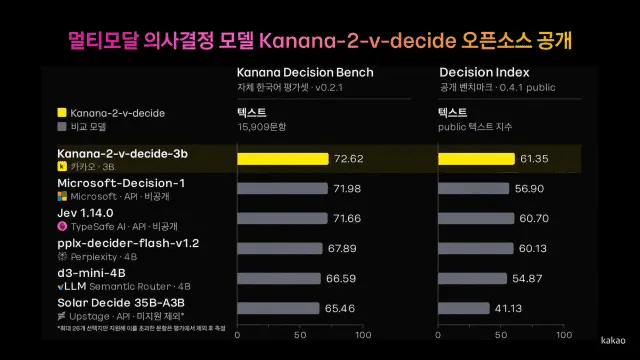
Kakao also says the model scored highest among the compared models on Kanana Decision Bench, its own Korean benchmark of 15,909 questions, and on the public Decision Index. The comparison included Microsoft's Decision-1, Typesafe AI's Zeb, Perplexity's pplx-decider-v1.1-27B and Upstage's Solar Decide. Typesafe AI, a US startup, unveiled Zeb in September, a sign that decision-focused models are gaining ground as components for agents that must pick tools, information and next steps.
The model is released under the Kanana Open License, which allows commercial use as well as research, so developers and companies in Korea and abroad can use it to build AI agent services.
Kakao plans to deploy the technology first in internal web search and product classification, refine it through real-world use and, over the longer term, merge search and decision-making functions.
Apps worth a look
SUMO: the number puzzleTap the right tiles, add them up, hit the target. Easy to learn, hard to master. Free, for all ages.
Dialo: learn languages by speakingTalk to an AI conversation partner; every sentence comes back corrected and explained in your language. 9 languages, A1 to C2.
ediviewer: read EDI files like documentsOpen EDIFACT and X12 messages, see every segment explained, convert to JSON/XML, export PDF and Excel. Runs locally, no upload.
giftdetect: the right gift in minutesPick who it is for, the occasion and their personality. The search engine reads product descriptions from local shops and ranks what fits. Free, no sign-up.
More from this day
See all →
Apple Charges $49.99 for Intelligence Usage Packs in Logic Pro
Redalpine closes $250M RAC VIII fund for European startups

Valkyrie Dynamics Raises €1M for Drone Interceptor Radar