Java4shell (CVE-2026-114938): a Java flaw and a safe check script
A critical Java bug, Java4shell, lets attackers run code on servers without logging in. A Korean security firm released a script that checks for it without attacking.
 SUMO· the number puzzle
 Dialo· learn languages by speaking
 ediviewer· read EDI files like documents
 giftdetect· the right gift in minutes
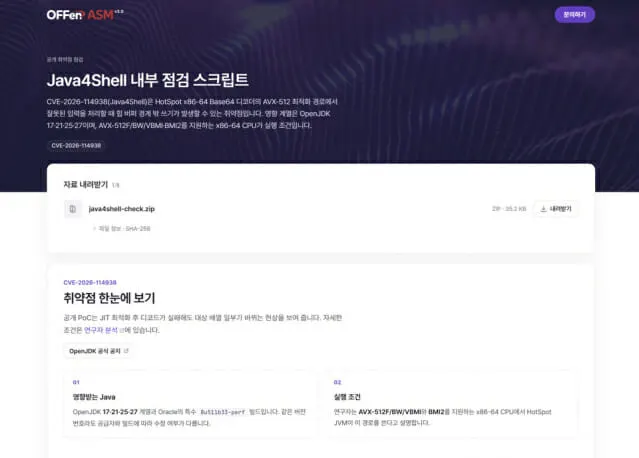
Java4shell is a critical remote code execution flaw in Java, and a new script can tell you whether your servers are exposed without firing an exploit at them. Korean offensive security firm Enki WhiteHat released the script and an analysis report on November 18.
The bug, tracked as CVE-2026-114938, sits in the code Java uses to speed up Base64 decoding. Feeding it crafted input corrupts memory, which lets an attacker run malicious code remotely and take over a server with no authentication. It scored 9.2 on the CVSS v4.0 scale, which the report rates as critical. The report lists OpenJDK 17, 21, 25 and 27 as affected. It traces the root cause to a flaw in the AVX-512 optimised path of the x86-64 Base64 decoder.
How does the Java4shell check script work?
Scanning from outside by sending attack-style input can crash a vulnerable process and knock a service offline. Enki WhiteHat's script avoids that. It sends no attack input and instead reads the local setup: the executable's architecture, vendor and version, plus whether the CPU supports AVX-512F, BW, VBMI and BMI2. Results come back as "suspected vulnerable", "fixed version in use" or "execution conditions not met". The script is downloaded from a dedicated diagnostic web page.
The report also covers mitigations you can apply immediately and a guide to the official patch. Oracle shipped an emergency patch on November 17 (US time) fixing 640 vulnerabilities across 21 product families, and Korea's internet agency KISA recommended the update on November 18.
Why Java4shell matters beyond your own code
Java runs core back-end systems at public agencies, banks and large companies. Safe application code does not help if the Java runtime underneath is flawed. According to Korean government statistics, 11,132 public information systems, or 71.28%, are built on Java, versus 6.58% on PHP.
There is a catch. Some Korean groupware, ERP and single sign-on products ship with an old Java development kit bundled inside. Updating the operating system's Java alone will not fix those.
This is the company's third such release after PHP2shell on October 23 and Node2shell, a Node.js Brotli bug, later that month. CEO Lee Seong-kwon said finding exposed assets before attackers do is the key.
Apps worth a look
SUMO: the number puzzleTap the right tiles, add them up, hit the target. Easy to learn, hard to master. Free, for all ages.
Dialo: learn languages by speakingTalk to an AI conversation partner; every sentence comes back corrected and explained in your language. 9 languages, A1 to C2.
ediviewer: read EDI files like documentsOpen EDIFACT and X12 messages, see every segment explained, convert to JSON/XML, export PDF and Excel. Runs locally, no upload.
giftdetect: the right gift in minutesPick who it is for, the occasion and their personality. The search engine reads product descriptions from local shops and ranks what fits. Free, no sign-up.
More from this day
See all →
Kakao founder Kim Beom-su acquitted again in SM stock case
South Korea CSAT cheating: 111 device cases, only 5 real uses

PS4 local LLM: a 2013 console runs Qwen3.5-9B at 39 tokens/s