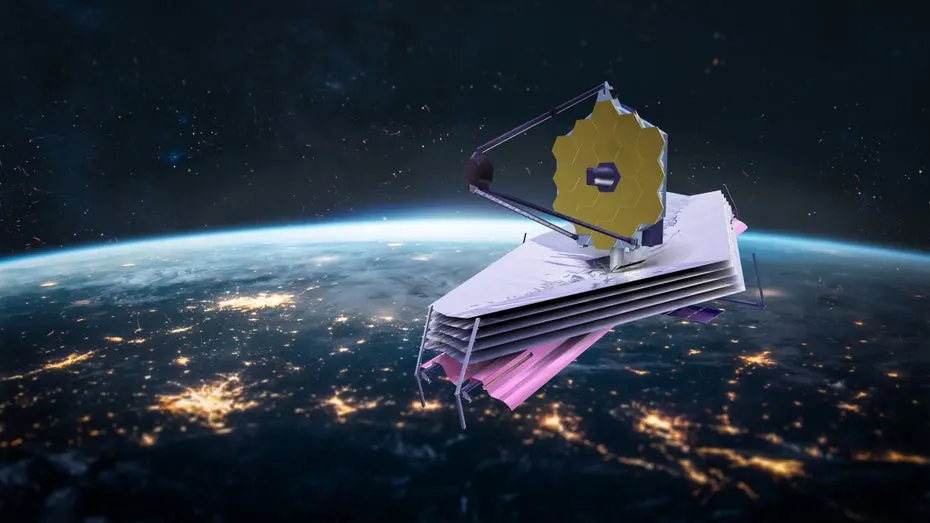
HD 158485: a James Webb calibration star is really two stars
A star used to calibrate the James Webb Space Telescope turns out to be a pair. Astronomers spotted it by timing pulses of light in old TESS data.
 SUMO· the number puzzle
 Dialo· learn languages by speaking
 ediviewer· read EDI files like documents
 giftdetect· the right gift in minutes
One of the reference stars used to calibrate the James Webb Space Telescope is not one star but two. HD 158485, listed until now as a single white star, hides a companion of almost the same brightness.
The finding comes from a team led by Chenglong Lv at the Xinjiang Astronomical Observatory in Ürümqi, China, with Professor Ali Esamdin and six co-authors. It was published in The Astrophysical Journal Letters. The star sits about 390 light-years away and appears in the calibration programme of the Space Telescope Science Institute in Baltimore.
How the hidden pair was found
From Earth the two stars are far too close together to be split in a normal image. Even at their widest, the gap looks like a coin seen from more than 260 kilometres away. The ESA's Gaia probe had already flagged the star as a likely binary, but nobody had an orbit. The stars are similarly bright, and one lap takes about as long as a year on Earth, which muddles position measurements.
So the team turned to archived data from NASA's TESS telescope, which watched the star for roughly five and a half years. Both stars are Delta Scuti stars, which swell and shrink in regular pulses. The team found six stable pulses of 75 to 95 minutes, split into two groups of three. Light takes longer to arrive when a star moves away from us, so the pulses of the two stars drifted early and late in opposite directions, by about 196 and 240 seconds.
That gave an orbit of 382.8 days around a shared centre. The lighter star has 81.8 percent of its partner's mass. A blind test, in which a model built on older data correctly predicted later timings, argued against an instrument glitch.
Does this affect James Webb's data?
Not in any way that spoils its measurements. The team modelled the pair and found infrared output 1.62 percent above a single-star prediction at 1 to 5 micrometres, and 2.53 percent at 5 to 28 micrometres, the range of the MIRI instrument. That just passes the two percent target for each calibration star. But Webb averages over dozens of such stars, and the authors call this a model comparison, not proof of a calibration error.
Some numbers remain estimates, because the tilt of the orbit is unknown. That includes the masses of about 2.2 and 1.8 Sun masses and a separation of roughly 239 million kilometres. A faint long-term drift in the pulses could also point to a third body, but that needs longer observations.
Apps worth a look
SUMO: the number puzzleTap the right tiles, add them up, hit the target. Easy to learn, hard to master. Free, for all ages.
Dialo: learn languages by speakingTalk to an AI conversation partner; every sentence comes back corrected and explained in your language. 9 languages, A1 to C2.
ediviewer: read EDI files like documentsOpen EDIFACT and X12 messages, see every segment explained, convert to JSON/XML, export PDF and Excel. Runs locally, no upload.
giftdetect: the right gift in minutesPick who it is for, the occasion and their personality. The search engine reads product descriptions from local shops and ranks what fits. Free, no sign-up.
More from this day
See all →
Why mobile shopping carts get abandoned: it's your brain
Air fryer emissions: up to 100 times fewer volatile compounds
Nvidia Blackwell smuggling: first signs of restricted GPU racks