Freewillin Tests AI That Gives Partial Credit on Handwritten Math
Korean edtech firm Freewillin is piloting an AI in its SchoolPlat courseware that scores handwritten math answers step by step, with teachers making the final call.
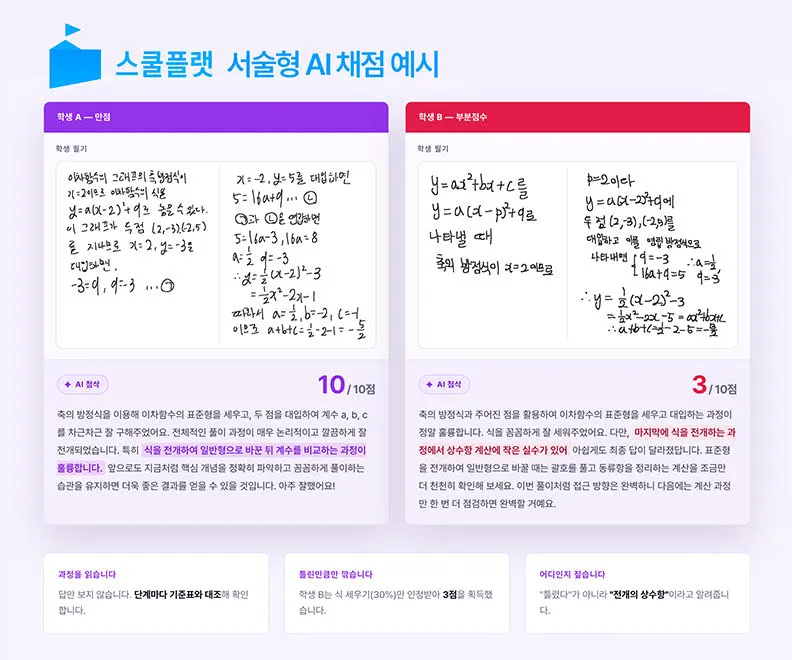
Korean math education company Freewillin is testing an AI that grades handwritten math solutions step by step and awards partial credit, leaving the final decision to teachers. The company said on the 3rd that its school courseware, SchoolPlat, was chosen for the Edutech Soft Lab pilot programs in both Jeonbuk and Seoul.
The programme is run by the Korea Education and Research Information Service (KERIS). Teachers use edtech products in real lessons and give feedback, which companies then use to improve their products. Jeonju National University of Education runs the Jeonbuk pilot, and Konkuk University runs the Seoul one.
How the grading works
The feature is called descriptive-answer AI grading. Students write their solutions by hand in a tablet app. The AI then checks each step against a rubric and drafts a score for every question along with written feedback. Rather than simply marking answers right or wrong, it gives partial credit per step and points to where a student needs to improve. It is designed to accept mathematically valid solutions even when the order of steps or the notation differs from the model answer.
Teachers see the question, the student's handwriting, the grading criteria and the AI's score and comments on one screen, and can edit them. Results are private by default, and the teacher decides whether to release them to students after review. Afterwards, the platform produces a report for descriptive questions and personalised worksheets of missed problems.
Results and context
The education ministry said in its second-half work plan in August that it would gradually expand essay-type assessment and use AI to support grading. More such assessment means a heavier marking load, so demand for tools that ease it is likely to grow.
According to Freewillin, a pilot from May to October involving 236 students at nine Jeonbuk schools led to improvements. One fourth-grade class at Namwon Dotong Elementary raised its average score from 72.4 to 81.6, and a fifth-grade class at Irimohyeon Elementary saw its correct-answer rate rise from 38% in May to 72% in September. Teacher feedback also led to new features, such as printing student names on incorrect-answer worksheets.
SchoolPlat is used in 3,641 elementary, middle and high schools nationwide, and is expanding from math to English and science. CEO Kwon Ki-sung said the aim is for AI to prepare grading drafts so teachers can focus on guiding students.
Apps worth a look
 SUMO: the number puzzle
Tap the right tiles, add them up, hit the target. Easy to learn, hard to master. Free, for all ages.
 Dialo: learn languages by speaking
Talk to an AI conversation partner; every sentence comes back corrected and explained in your language. 9 languages, A1 to C2.
 ediviewer: read EDI files like documents
Open EDIFACT and X12 messages, see every segment explained, convert to JSON/XML, export PDF and Excel. Runs locally, no upload.
More from this day
See all →
Apple: Hard to Predict When iPhone Duo Supply Will Catch Up
Apple Watch Audio Intelligence enters beta in iOS 27.3
MoneySmart reports customer data breach in Singapore and Hong Kong