Flownix and Asan Medical Center AI Win All MICCAI 2026 Accuracy Tracks
Flownix and Seoul's Asan Medical Center took first place in all three accuracy categories of the MICCAI 2026 4D Flow MRI challenge with AI that shortens scans.
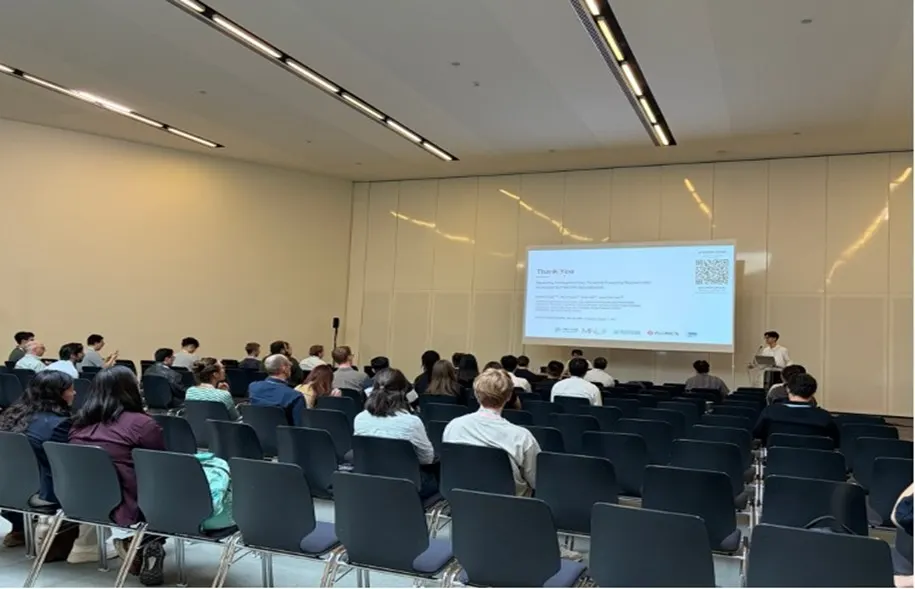
Flownix, a medical imaging software company, and a research team at Asan Medical Center in Seoul have won first place in all three accuracy categories of the 4D Flow MRI Reconstruction Challenge at MICCAI 2026, the international conference on medical image computing. The company announced the result on October 29.
Why scan time matters
4D flow MRI captures blood flow through the heart and vessels in three dimensions over a single heartbeat, producing figures such as flow velocity and the force exerted on vessel walls. Doctors use it to assess the risk of aortic aneurysm, vessel narrowing and aortic dissection, and to plan surgery. A high-resolution scan, however, takes 30 to 60 minutes, which has kept the technique from wide clinical use.
This year's challenge targeted that problem. Teams received scan data cut to between one-tenth and one-fiftieth of the original and had to restore the blood flow information with AI as accurately as possible. Less data means a proportionally shorter scan.
Results
The challenge drew 264 registrants, and 22 teams, including UCLA, ETH Zurich, UCSF, Northwestern University and Canon Medical Systems, made the final ranking. The collaboration of Flownix, the team of Professor Joon-Goo Lee at Asan's biomedical engineering research center, and Kangwon National University shared first place in reconstructing images from sparse data. It won outright in the two generalization categories: applying the model to unseen hospitals and diseases, and to unseen body regions. It was the only team to finish first in all three.
All teams trained only on aortic data. They were then tested, without retraining, on data from other hospitals, scanners and conditions, and on regions such as cerebral vessels, the carotid artery, the portal vein and the renal artery. In both generalization categories the team ranked first on all four metrics, covering image similarity, error, and the magnitude and direction of flow velocity errors. The company says this points to a way past the limitation of medical AI that works only on data from the hospital it was trained on.
The method exploits the regular, repeating nature of blood flow across the heartbeat to filter out distortions in short scans and recover true flow information. The team presented first among 12 invited teams at the challenge workshop. The two organizations have collaborated since 2014, and Flownix develops Flownix Streamliner, software that analyzes flow velocity and direction in 4D flow MRI.
CEO Ho-jin Ha said the company aims to link the technology to its flow analysis platform to speed clinical adoption of 4D flow MRI. Professor Lee said the goal is to bring it into real clinical settings so patients can get accurate diagnoses from shorter exams.
More from this day
See all →
Venttup Raises $3m Pre-Series A for Bengaluru Manufacturing Hub

Polymarket launches ultra-short Up/Down crypto markets in US

OpenAI Reportedly Plans to Buy Google TPU Chips, Eyeing Life Beyond Nvidia