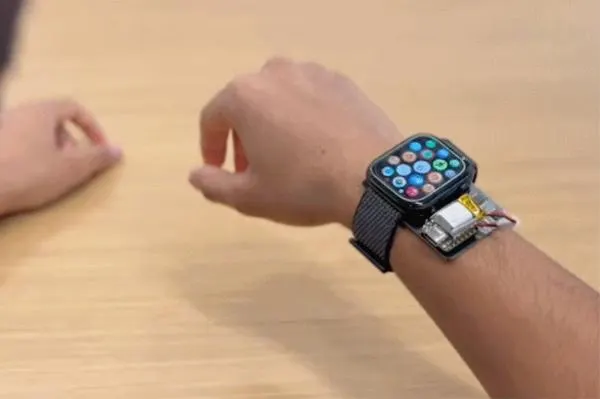
EITWatch: a smartwatch band that reads gestures from your wrist
Hands full of flour or groceries? Northwestern researchers built EITWatch, a wrist module that lets you control a smartwatch with finger gestures, no screen touch needed.
 SUMO· the number puzzle
 Dialo· learn languages by speaking
 ediviewer· read EDI files like documents
 giftdetect· the right gift in minutes
You are carrying shopping bags, or your hands are covered in flour, and the smartwatch buzzes. You can't tap it. A team at Northwestern University's McCormick School of Engineering has a possible fix called EITWatch, a device that sits between the watch and your wrist and reads hand gestures instead of touches.
How does EITWatch work?
Eight small gold-plated electrodes pick up changes in electrical impedance, which reflects how the muscles and tendons inside your wrist are moving. A weak current leaves the electrode at the 12 o'clock position and is measured at the other seven, using a method the team calls Multi-Depth Scanning. It scans 48 frames per second and measures 35 patterns. Each hand shape changes those patterns, and that is how the system tells gestures apart. The module also carries chips for generating, amplifying and switching the signal and processing the data.
Which gestures does it recognise?
There are two groups. Macro gestures are big hand shapes: the "aloha" sign with thumb and little finger out, a finger gun, a single raised index finger, an open palm and a fist. A thumbs-up also works, though it isn't in the demo video.
Micro gestures are small finger movements. A quick pinch of index finger and thumb starts or pauses music. Rubbing the two together is a swipe that skips tracks. Opening the hand fully, called a stretch, goes back a page. A quick roughly 90-degree palm turn, the wrist flip, returns to the home screen.
In a test with 12 participants, accuracy of identifying gestures was above 90 percent.
What are the limits?
It is still a prototype, though already small enough not to get in the way, and the team plans to shrink it further. The researchers trained the algorithm on everyday movements to avoid false inputs, but a hand could still accidentally make a gesture. A power switch, or a special gesture to turn the system on and off, may end up being necessary.
Gesture input could also be done with cameras, ultrasound or accelerometers. Sensing how easily current flows through your muscles looks more reliable, and it could help people who mistap on tiny screens or find fine finger control hard.
Apps worth a look
SUMO: the number puzzleTap the right tiles, add them up, hit the target. Easy to learn, hard to master. Free, for all ages.
Dialo: learn languages by speakingTalk to an AI conversation partner; every sentence comes back corrected and explained in your language. 9 languages, A1 to C2.
ediviewer: read EDI files like documentsOpen EDIFACT and X12 messages, see every segment explained, convert to JSON/XML, export PDF and Excel. Runs locally, no upload.
giftdetect: the right gift in minutesPick who it is for, the occasion and their personality. The search engine reads product descriptions from local shops and ranks what fits. Free, no sign-up.
More from this day
See all →
NYT tells freelancers not to use Photoshop 2027 over hidden AI

John Motson's voice returns to EA Sports FC 27 via generative AI

Jensen Huang's Nvidia return: Trump dialed into the board meeting
Satudora data leak: 229,026 LINE accounts exposed for 16 months
More in: Hardware
See all →
Starlink split network: how to separate 2.4GHz and 5GHz Wi-Fi
TV ACR tracking: your smart TV may check what you watch twice a second

LG OLED edge rot: a brand-new replacement panel had dead pixels