ChatGPT at work: BCG consultants did better, but learned little
In a study of BCG consultants, ChatGPT users beat the search group on every data task. Without the chatbot, they showed no sign of knowing more.
 SUMO· the number puzzle
 Dialo· learn languages by speaking
 ediviewer· read EDI files like documents
 giftdetect· the right gift in minutes
Give a consultant ChatGPT and a data science task they were never trained for, and they do noticeably better. Take ChatGPT away, and the gain seems to vanish. That is the finding of a new study in Nature Human Behaviour, and the authors compare the effect to wearing a powered exoskeleton suit.
The paper, "Generative AI and the temporary upskilling of knowledge workers," comes from researchers at Boston University, BCG's Henderson Institute and OpenAI. It involved 573 BCG consultants, with 487 used as the main sample. None were data science specialists, and none were required to write code in their jobs.
How was the ChatGPT study run?
Participants were split at random into two groups. One got training on ChatGPT (GPT-4) and prompting. The other got training on using Google search and technical Q&A sites. Each person then worked on two tasks, randomly picked from three outside their field: cleaning data in Python, spotting errors in an analytical model, and building a model to predict soccer match results from game data. The tasks were set so that handing everything to the AI would not produce the right answer. A human had to make judgment calls along the way.
The ChatGPT group scored higher than the search group on every task. They were also faster on the coding and prediction tasks. Consultants who already had some programming experience and used ChatGPT came close to the results of working data scientists who did not use AI, on the programming and statistics tasks.
Did people actually learn anything?
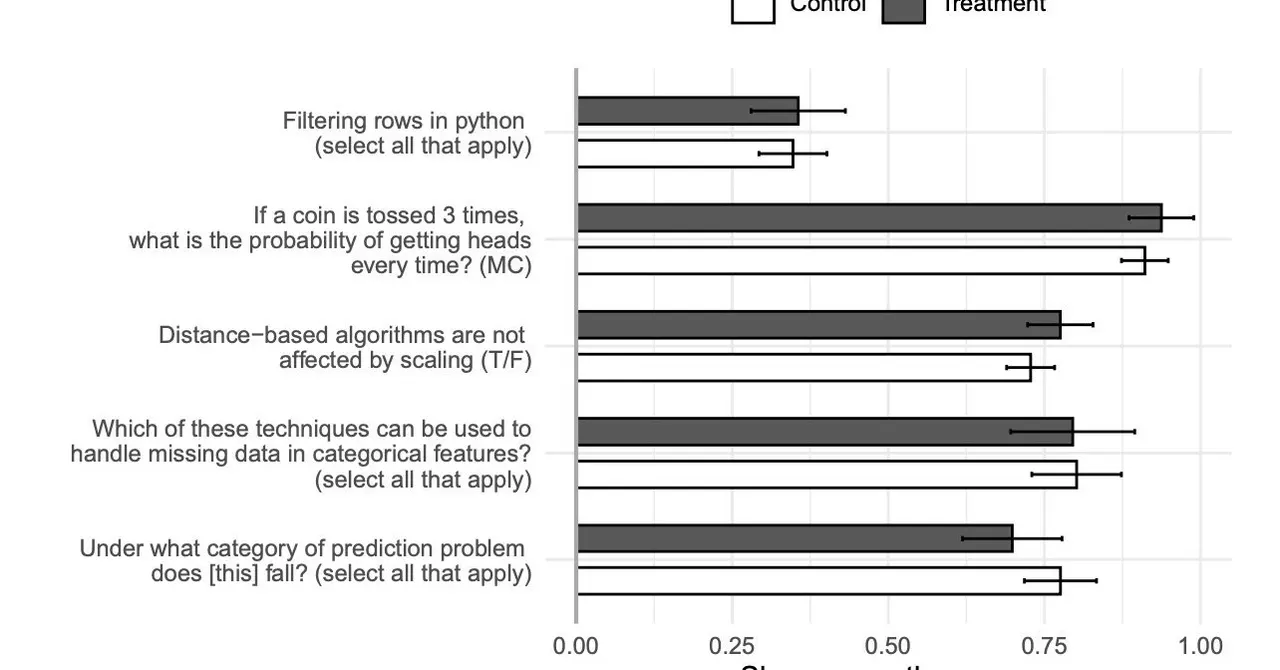
Apparently not. Afterwards, both groups answered technical questions in the same fields, this time without ChatGPT. The study found no evidence that the ChatGPT group scored higher.
There was a second effect. After the experiment, ChatGPT users rated the AI's abilities more highly than the control group did. That held for every problem GPT-4 cannot actually solve, where they were more likely to think it could.
The takeaway is that generative AI can lift people working outside their expertise, but the boost lasts only while they are using it. For anyone hoping to learn a skill through a chatbot, that is worth knowing.
Apps worth a look
SUMO: the number puzzleTap the right tiles, add them up, hit the target. Easy to learn, hard to master. Free, for all ages.
Dialo: learn languages by speakingTalk to an AI conversation partner; every sentence comes back corrected and explained in your language. 9 languages, A1 to C2.
ediviewer: read EDI files like documentsOpen EDIFACT and X12 messages, see every segment explained, convert to JSON/XML, export PDF and Excel. Runs locally, no upload.
giftdetect: the right gift in minutesPick who it is for, the occasion and their personality. The search engine reads product descriptions from local shops and ranks what fits. Free, no sign-up.
More from this day
See all →
Ladybird browser alpha: a new engine built from scratch

Best Kobetsu data breach: grades and bank details of up to 50,000 exposed

Why coffee makes you poop: 50 people swallowed a SmartPill