AT 2025abao: astronomers watch one star swallow another
For the first time, astronomers followed a star as it sank into its giant companion in Andromeda, from a slow seven-year spiral to a final flash.
 SUMO· the number puzzle
 Dialo· learn languages by speaking
 ediviewer· read EDI files like documents
 giftdetect· the right gift in minutes
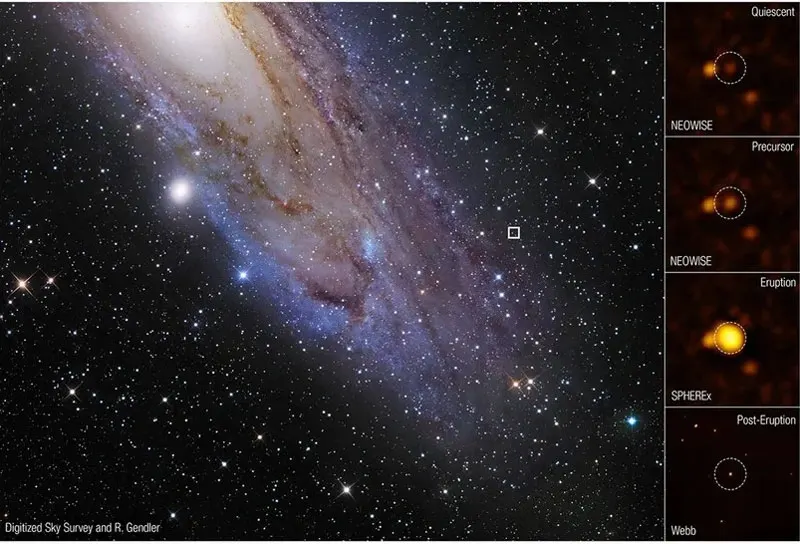
Stars eating stars is something theorists have modelled for decades. Now someone has actually watched it happen. The event, called AT 2025abao, played out in the Andromeda galaxy, about 2.5 million light years away, and astronomers say it is the first observation to confirm those models.
The system held two stars. The larger one was an aging giant of the type called an AGB star (asymptotic giant branch), roughly seven times the mass of the Sun and about 350 times its radius. Its companion was a modest 0.7 solar masses. In 2018 the smaller star began to dip into the giant's outer gas layers and slowly spiral inward.
What is common envelope evolution?
That process has a name: common envelope evolution. Both stars end up inside one shared cloud of gas. The smaller star ploughs through it, gets slowed by drag, and loses orbital energy, so its orbit shrinks. The lost energy heats the gas and throws some of it off.
According to the researchers' reconstruction, this went on for about seven years, with the system gradually getting brighter. Then, in late 2025, it flared sharply and ejected material. The team links that to the companion plunging into the giant's core and the two merging.
How did astronomers piece it together?
The first hints of odd behaviour turned up in archived data from NASA's infrared NEOWISE telescope and the WINTER telescope at Palomar Observatory. Further optical and infrared observations tracked how brightness and spectrum changed. The James Webb Space Telescope looked at the system just 47 days after the flash, and its data helped pin down the ejected material. The estimate is about 0.1 to 0.2 solar masses of gas from the giant's outer layers.
The authors call this the first time the whole sequence has been traced, from the start of the plunge to the final outburst. One caveat remains: the two stars may have kept their identities, just on much tighter orbits. Settling that will take more observations.
Apps worth a look
SUMO: the number puzzleTap the right tiles, add them up, hit the target. Easy to learn, hard to master. Free, for all ages.
Dialo: learn languages by speakingTalk to an AI conversation partner; every sentence comes back corrected and explained in your language. 9 languages, A1 to C2.
ediviewer: read EDI files like documentsOpen EDIFACT and X12 messages, see every segment explained, convert to JSON/XML, export PDF and Excel. Runs locally, no upload.
giftdetect: the right gift in minutesPick who it is for, the occasion and their personality. The search engine reads product descriptions from local shops and ranks what fits. Free, no sign-up.
More from this day
See all →


More in: Science
See all →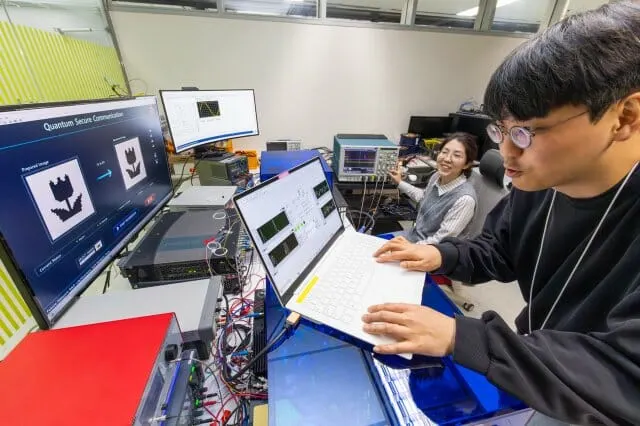
KT and LG send an image over quantum signals with QSDC
Walk score and steps: moving to a walkable city adds 1,100 a day

Los Santos flooding study: scientists drown a GTA 5 city