Aeon and Mujin Open Physical AI Hub, Automating Half of Work
Aeon and robot software maker Mujin opened a cross-dock near Tokyo where physical AI robots already handle half the work, with an 80% target for 2030.
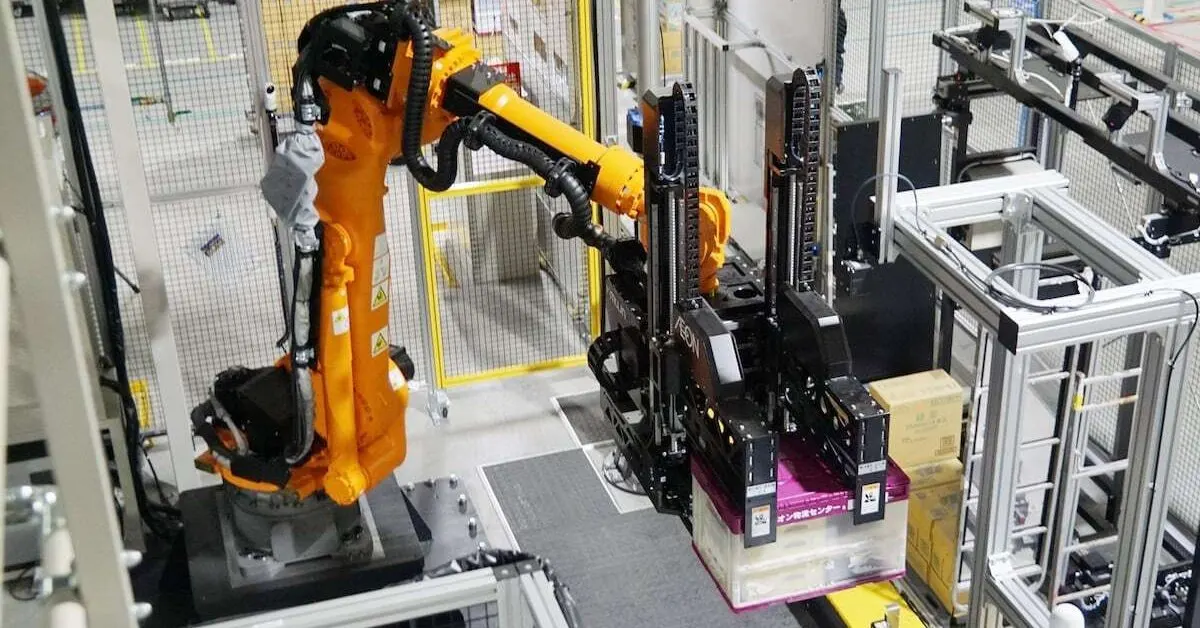
Aeon and robot-control software company Mujin showed the press their new distribution hub, Aeon Kawaguchi-Higashi XD, in Kawaguchi, Saitama Prefecture, on October 29. The site runs robots powered by "physical AI", which lets machines act autonomously. About half of all work is already automated, and the companies plan to raise that to 80% by 2030.
The cross-dock began full operation the same day and serves roughly 200 Maibasket小型 supermarkets in the Tokyo area. Robots use sensors to recognize incoming cases and place them on conveyors, while 82 automated guided vehicles move individual items to temporary storage.
Robots that judge for themselves
In the loading area, robot arms stack products onto cart racks sorted by destination store. Conventional robots follow human instructions exactly, but physical AI decides on its own, for example by considering product weight so loads do not collapse. More than 90 robots are in operation, saving the equivalent of 39 workers per day. Hiroki Yamamoto, president of logistics subsidiary Aeon Global SCM, said robot productivity is three to four times that of people.
This is the first time Aeon has automated the whole flow from sorting to loading. The company is now studying how to automate everything from receiving to shipping, and plans to extend the approach to store logistics for its supermarkets and drugstores nationwide.
Why it matters
Japan's working-age population keeps shrinking, and labor shortages in logistics are expected to worsen. Acumen Research and Consulting estimates the global physical AI market will grow from $5.02 billion in 2025 to $82.79 billion in 2035, a 16.5-fold increase. The government of Prime Minister Sanae Takaichi has named physical AI one of 17 strategic fields, with about 10.5 trillion yen in public and private investment envisioned through fiscal 2040.
Japan Research Institute senior researcher Kaori Iwasaki stressed that safety must be ensured so AI does not harm people. She advised starting where possible and building knowledge along the way, noting that reaching a finished form could take decades.
More from this day
See all →
Amazon Stockpiles Billions in Idle Nvidia GB300 AI Servers
UBTech, Agility Robotics, BluMentis Eye Farms for Humanoid Robots

NIS 2, REC and DORA: France's Grace Period on Cyber Rules Ends