Mars rock "potato chips": what Curiosity and Perseverance found
Thin, curled slabs on Mars look like potato chips. NASA's Curiosity drilled next to them, while Perseverance found pale, opal-like rocks.
 SUMO· the number puzzle
 Dialo· learn languages by speaking
 ediviewer· read EDI files like documents
 giftdetect· the right gift in minutes
Some rocks on Mars look like potato chips. NASA's Curiosity rover spent part of November studying exactly those thin, flat slabs, while its colleague Perseverance looked at something just as odd 3,700 kilometres away.
What are the Mars "potato chip" rocks?
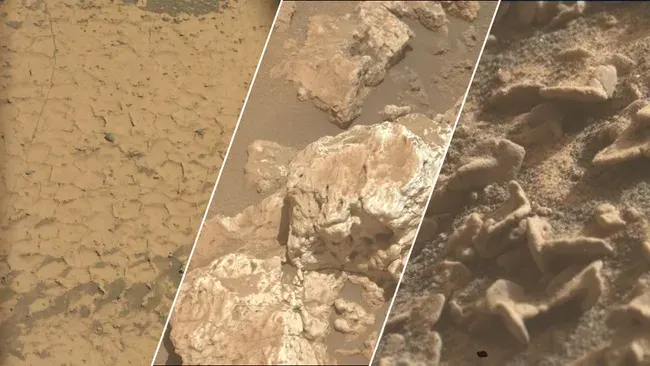
Curiosity, active since 2012, is climbing Mount Sharp, a mountain about 5.5 kilometres high. At a spot called "Nazca" it finished its 49th drill hole and photographed the neighbouring ground on 7 November. Thin slabs stick out of the bedrock there, and a NASA mission report compares them to potato chips.
Scientists think they are crystals that formed when mineral-rich water seeped into tiny cracks in the rock. The crystals are harder than the rock around them, so they weather more slowly. The Martian wind gradually exposes them.
Studying them was not easy. Curiosity vaporises tiny spots of rock with a laser and reads the colours of the resulting hot gas. Mineralogist Susanne Schwenzer of the Open University says a pebble that is too small can shift when the laser hits it. So the team looked for larger slabs that stay put. The rover also fed drill powder into an oven to measure released gases. That takes a lot of power, and Curiosity's plutonium-powered battery weakens over the years. The rover had to pause for several days to recharge.
On 13 November the mast camera spotted polygon patterns in the ground, framed by narrow ridges. Drying minerals, temperature swings or pressure from old overlying layers could all cause them, so the cause stays open. All of this comes from ongoing NASA work reports, and peer-reviewed studies are still to come.
What did Perseverance find near Jezero crater?
Outside Jezero crater, in an area called "Idubi", Perseverance picked up pale, pitted chunks on 29 October. According to researcher Candice Bedford of Purdue University, they are not volcanic. Laser readings point to hydrated silica, a quartz-like mineral with water bound in it, similar to Earth's opal.
On Earth it forms in hot springs or from groundwater and can preserve dead microorganisms for billions of years. The chunks are big enough for the robotic arm to measure up close. They show past water activity, but not life, since the mineral also forms through pure chemistry.
The day after the Idubi images, Perseverance had a fault in its main radio. Engineers are also checking its backup radio, and the 25-year-old orbiter Mars Odyssey has problems. Proving ancient microbes would need samples brought to Earth, but NASA's sample return programme is delayed by high costs.
Apps worth a look
SUMO: the number puzzleTap the right tiles, add them up, hit the target. Easy to learn, hard to master. Free, for all ages.
Dialo: learn languages by speakingTalk to an AI conversation partner; every sentence comes back corrected and explained in your language. 9 languages, A1 to C2.
ediviewer: read EDI files like documentsOpen EDIFACT and X12 messages, see every segment explained, convert to JSON/XML, export PDF and Excel. Runs locally, no upload.
giftdetect: the right gift in minutesPick who it is for, the occasion and their personality. The search engine reads product descriptions from local shops and ranks what fits. Free, no sign-up.