KISA Tests 10 IP Cameras: Three Fail Basic User Authentication
South Korea's KISA and the Korea Consumer Agency tested 10 popular IP cameras. Three lacked proper user authentication, exposing footage and camera controls to attackers.
 SUMO· the number puzzle
 Dialo· learn languages by speaking
 ediviewer· read EDI files like documents
 giftdetect· the right gift in minutes
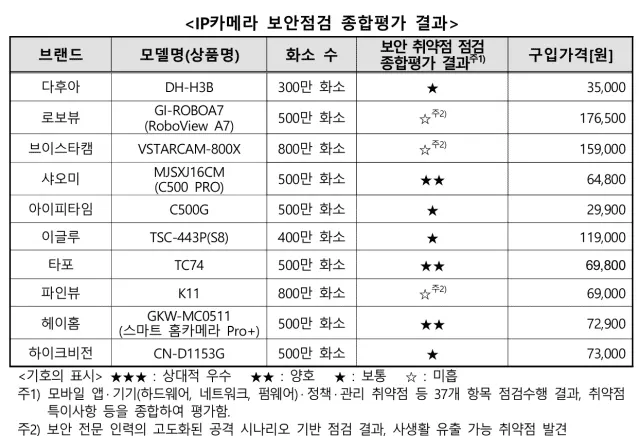
The Korea Internet & Security Agency (KISA) and the Korea Consumer Agency have tested the security of 10 IP cameras sold in South Korea. Three of them lacked adequate user authentication, which could let attackers expose users' privacy. The affected models are the RoboView GI-ROBOA7 (RoboView A7), the VSTARCAM-800X and the Fineview K11.
The tests ran for about four months, from February 25 to June 8. The other cameras were the Dahua DH-H3B, Xiaomi MJSXJ16CM (C500 PRO), ipTIME C500G, Eufy-style rival Igloo TSC-443P (S8), Tapo TC74, Hikvision CN-D1153G and Heyhome GKW-MC0511 (Smart Home Camera Pro+). The agencies picked them based on online shopping rankings and consumer survey results.
What the tests found
Evaluators checked 37 items across three areas: the device itself (hardware, network, firmware), the mobile app that controls it, and the manufacturer's policies, including security updates and privacy. Using attack scenarios drawn up by security specialists, they concluded that improvement was needed overall.
In the three cameras with weak authentication, an attacker could download another person's images and video without permission, or forcibly activate or manipulate the camera. On the device side, four models had active exposed test ports that risk system access and data leaks. Eight models did not use secure communication protocols, so user data could leak in transit. Every model had weak firmware security settings.
Five models did not enforce a safe password policy, such as requiring a combination of two character types and at least 10 characters. For six models, the period of security update support could not be confirmed.
Fixes and next steps
KISA recommended that the makers of the three cameras fix the flaws quickly. Fixes are complete for the RoboView and Fineview models, and the third is in progress. All 10 manufacturers received the results and remediation guidance, and have submitted quality improvement plans to the Korea Consumer Agency. KISA will keep checking whether those plans are carried out.
This is the second joint check of everyday digital products, following a 2025 safety survey of robot vacuum cleaners. KISA's Lee Yong-pil said manufacturers and retailers should apply security across a product's whole life cycle, and consumers should practice good security habits.
Apps worth a look
SUMO: the number puzzleTap the right tiles, add them up, hit the target. Easy to learn, hard to master. Free, for all ages.
Dialo: learn languages by speakingTalk to an AI conversation partner; every sentence comes back corrected and explained in your language. 9 languages, A1 to C2.
ediviewer: read EDI files like documentsOpen EDIFACT and X12 messages, see every segment explained, convert to JSON/XML, export PDF and Excel. Runs locally, no upload.
giftdetect: the right gift in minutesPick who it is for, the occasion and their personality. The search engine reads product descriptions from local shops and ranks what fits. Free, no sign-up.
More from this day
See all →
NHarvestX 2026: 7 Agtech Startups Share Results of NH Field Trials

Mashup Ventures Closes 25.9 Billion Won First Believer Fund 5
Japan Sets Up Working Group to Study Website Blocking