Galaxy S9+ with a cracked screen turned into a Debian LTE router
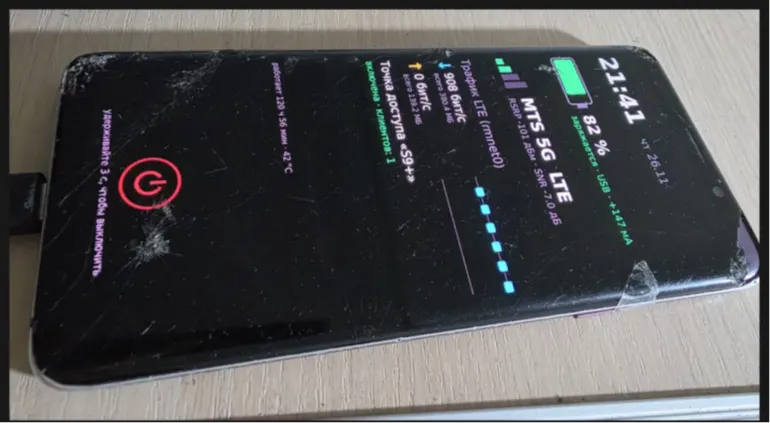
A broken 2018 Galaxy S9+ with a taped-on power button now runs Debian 13 and shares mobile internet at home. It took one day and an AI agent.
 SUMO· the number puzzle
 Dialo· learn languages by speaking
 ediviewer· read EDI files like documents
 giftdetect· the right gift in minutes
A Galaxy S9+ from 2018, with a cracked screen, torn-out volume buttons and a power button held on by tape, now works as an LTE router running Debian 13. Its owner built it in a single day, in between looking after the kids, cooking and shopping, with an AI agent doing much of the work alongside him.
The phone boots Debian straight on the Linux kernel, not Android. The Samsung modem still handles the cellular connection, and the phone shares internet over a 5 GHz hotspot called "S9+" while staying connected to home Wi-Fi at the same time. The screen shows battery, carrier and signal level, traffic, connected devices, uptime and temperature.
Why use a Galaxy S9+ as a router?
The phone came out in March 2018 and cost 840 dollars in the US. Even so, its modem can combine six carriers and use 4x4 antennas, which is more than the modems in many cheap LTE routers. It also has enough CPU and memory to run home services next to the hotspot.
The downsides are real. It has no external antenna port and no Ethernet, so a router with an outdoor antenna wins if the tower is far away. The author did not benchmark routing. One quick test downloaded a 10 MB file in 12.3 seconds, about 6.5 Mbit/s, with a signal strength (RSRP) of -100 dBm in an early snapshot.
What it took to boot Debian
The bootloader must be unlocked. On this Exynos model, SM-G965F/DS, that meant switching on OEM unlocking in developer options. The author built Samsung's own Linux 4.9 kernel sources with its old compiler, then fixed three problems.
Two were Samsung protections that panicked the boot: DEFEX, which looks for an Android-only policy file, and a guard that only lets system-level programs run from Android partitions. Both were disabled. The third was an old ext4 bug that made the kernel treat a correctly enlarged filesystem as corrupted. A one-line change in ext4_check_descriptors fixed it.
Eleven Android factory processes still run in a separate directory, because the modem will not register on the network without them. The modem software stays closed.
The trade-off is an old kernel that will not get updates, with some protection turned off. The author accepts that for a home device. After more than five days of uptime, a connection watchdog logged 32 reconnects and 2 full modem restarts, nearly all of them on the debugging day, and none in the last four days.
Apps worth a look
SUMO: the number puzzleTap the right tiles, add them up, hit the target. Easy to learn, hard to master. Free, for all ages.
Dialo: learn languages by speakingTalk to an AI conversation partner; every sentence comes back corrected and explained in your language. 9 languages, A1 to C2.
ediviewer: read EDI files like documentsOpen EDIFACT and X12 messages, see every segment explained, convert to JSON/XML, export PDF and Excel. Runs locally, no upload.
giftdetect: the right gift in minutesPick who it is for, the occasion and their personality. The search engine reads product descriptions from local shops and ranks what fits. Free, no sign-up.
More from this day
See all →
Peach data leak: 9.44 million records exposed via KARTE
Can You Build a Silicon Transistor in a Garage? One Man's Budget

Putin wants a choose-your-AI screen on every Russian smartphone