BeeWallet turns USDT into Korean won for tourists at ATMs
Korean fintech Cocon showed a wallet that turns USDT into won you can spend by QR code or pull out of an ATM. It still runs on a testnet.
 SUMO· the number puzzle
 Dialo· learn languages by speaking
 ediviewer· read EDI files like documents
 giftdetect· the right gift in minutes
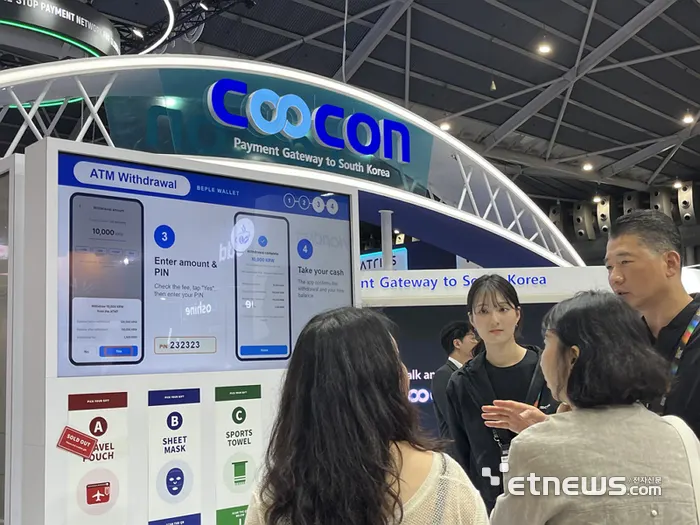
Pick USDT on your phone, and the screen offers to turn it into Korean won. Then you pay by QR code or take cash out of an ATM. That is BeeWallet (Bi-Wallet in Korean), a stablecoin wallet for tourists shown by Korean fintech firm Cocon at Singapore Fintech Festival 2026.
How does BeeWallet work?
The festival ran from 18 to 20 November at Singapore Expo. In the demo, a foreign visitor arriving in Korea signs up and completes KYC, the identity check financial services require. They then send USDT or USDC from an outside crypto wallet and top up a won balance.
From there, the money works like local cash. Cocon says it connects more than 2 million QR merchants, over 100,000 outlets of major franchises and more than 40,000 ATMs. The core idea is to convert stablecoins brought from abroad into a payment method that works in Korea. A Cocon representative said the company is preparing a model for tourists to top up, pay and withdraw after landing, and that the demo currently runs on a testnet, a trial network without real money.
AI agents trading currency
Hyundai Card and JP Morgan showed a proof of concept in which an AI agent handles a foreign exchange trade. Told to sell pounds and buy euros, the agent asked three banks for quotes. It picked JP Morgan's blockchain payment network, Kinexys, which offered the best terms, and ran the trade. Hyundai Card's euro balance on screen went up afterwards.
JP Morgan stressed that the AI does not verify trades itself. The bank's systems check each one against preset rules. The two firms are considering a follow-up with several AI agents trading at once, plus how to verify their identities and manage permissions.
Other Korean fintech on show
Hecto Financial presented a cross-border payment and settlement tool that lets foreign companies collect Korean payments without setting up a local entity, and it also covers USDC transfers. PFCT showed Airpack, a credit scoring and lending tool, and claims about 30 times faster data processing and strategy analysis cut from two weeks to one day. Teawave, which runs I'm In, turned the Korean rotating savings circle called gye into an app, with a launch planned in 2027 with Taiwanese digital banks around the local version, hojohoe. Infinite Block showed Kripton, a custody wallet for institutions that splits private keys using MPC.
Apps worth a look
SUMO: the number puzzleTap the right tiles, add them up, hit the target. Easy to learn, hard to master. Free, for all ages.
Dialo: learn languages by speakingTalk to an AI conversation partner; every sentence comes back corrected and explained in your language. 9 languages, A1 to C2.
ediviewer: read EDI files like documentsOpen EDIFACT and X12 messages, see every segment explained, convert to JSON/XML, export PDF and Excel. Runs locally, no upload.
giftdetect: the right gift in minutesPick who it is for, the occasion and their personality. The search engine reads product descriptions from local shops and ranks what fits. Free, no sign-up.
More from this day
See all →Hugendubel, Tolino Cloud and eBook.de offline after cyberattack

YouTube app icons: 7 new designs, some retro, are in the works

PC repair job interview: the voltage switch trap he suggested

Google's new 3D emoji need 6GB RAM and 10GB storage, now explained
More in: Crypto
See all →
Chainflip hack: $12 million stolen, hacker offered 10% bounty

Fusionist ACE bridge exploit: $2M hack, then a $3.7M scramble
Upbit and Bithumb halt CYBER transfers after suspected bridge exploit