AirSnitch Wi-Fi attack breaks client isolation in about 2 seconds
Researchers found that Wi-Fi client isolation, the feature meant to keep strangers on your network from snooping, failed in every router and network they tested.
 SUMO· the number puzzle
 Dialo· learn languages by speaking
 ediviewer· read EDI files like documents
 giftdetect· the right gift in minutes
You are on a guest Wi-Fi, and the router promises that other devices cannot see your traffic. A new research paper says that promise is much weaker than it sounds. The attack is called AirSnitch, and on one Netgear router it took about two seconds to set up.
The paper comes from researchers at the University of California, Riverside and other institutions. It was presented in February at the NDSS security conference in San Diego. It targets "client isolation", a feature that stops devices on the same Wi-Fi network from talking to each other. Every home router, business router and university network the team examined could be beaten by at least one of the attacks, which allows eavesdropping and injecting data.
Why does Wi-Fi client isolation fail?
There is no industry-wide standard for client isolation. Each manufacturer built its own version, and the researchers found gaps in all of them. They describe three main routes.
The first abuses the group temporal key (GTK), a shared encryption key used to broadcast to every device on the network. An attacker can hide a packet meant for one victim inside what looks like a router broadcast, and the victim accepts it.
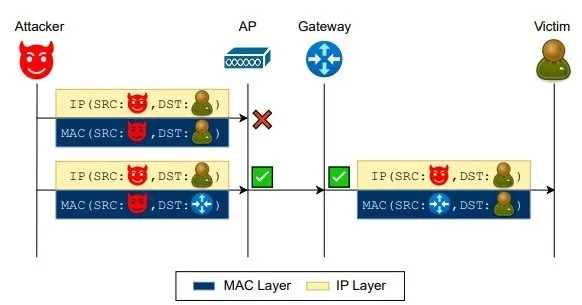
The second is called gateway bouncing. Many devices block direct device-to-device traffic at the MAC layer (hardware addresses) but not at the IP layer. So the attacker addresses data to the router and names the victim as the final IP destination. The router simply forwards it.
The third is port stealing. A modern access point has several connection points (BSSIDs) for different bands and for main and guest networks, each treated as a separate virtual port internally. If an attacker connects through, say, the guest network while spoofing the victim's MAC address, the access point believes the victim has moved and sends the victim's incoming traffic to the attacker.
What can an attacker actually do?
On an open guest network with no password, this leaks the victim's traffic without its usual encryption. Spoofing the router's own MAC address also captures traffic heading out to the internet.
Combining interception with re-injection gives a man-in-the-middle position that the victim barely notices. In tests, the team listened in from a guest network on a device on the main Wi-Fi without delay. They also sniffed a company's RADIUS authentication server traffic, cracked a password, and set up a rogue access point that captured traffic and credentials.
Apps worth a look
SUMO: the number puzzleTap the right tiles, add them up, hit the target. Easy to learn, hard to master. Free, for all ages.
Dialo: learn languages by speakingTalk to an AI conversation partner; every sentence comes back corrected and explained in your language. 9 languages, A1 to C2.
ediviewer: read EDI files like documentsOpen EDIFACT and X12 messages, see every segment explained, convert to JSON/XML, export PDF and Excel. Runs locally, no upload.
giftdetect: the right gift in minutesPick who it is for, the occasion and their personality. The search engine reads product descriptions from local shops and ranks what fits. Free, no sign-up.
More from this day
See all →
Nāpōwawāʻenakaulua: Webb Finds Earliest Quasar Pair Ever

United Airlines AI agent ban: bots can't tick the check-in box

Jensen Huang resigns as Nvidia CEO; Colette Kress steps in as interim

Windows WinSxS folder: the DISM command that frees up to 10 GB
More in: Security
See all →
ScreenConnect RMM+ plugin flaw lets hackers hit 288 PCs
Is your smart TV spying on you? Questions about TV data
Krakow attacker's iPhone may need Apple's help to unlock